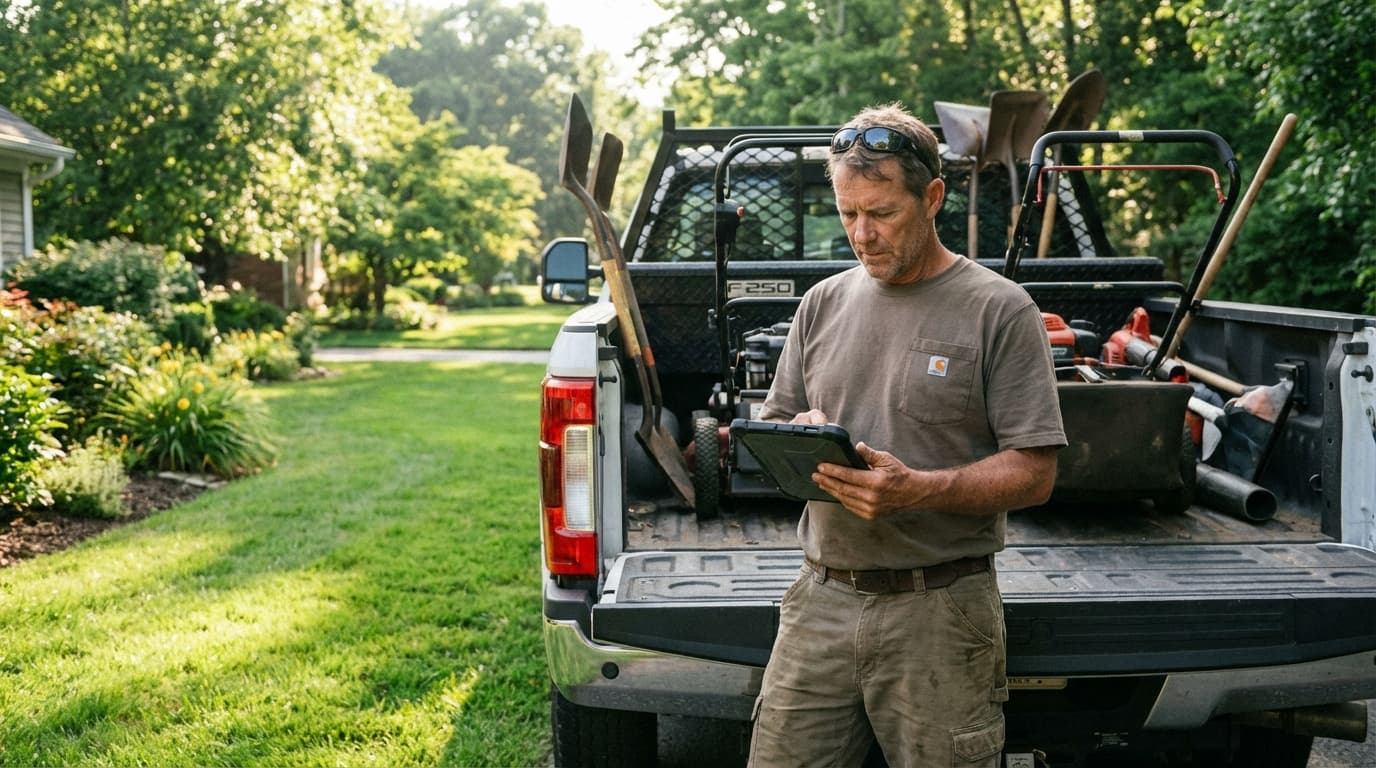
Here's the thing most landscaping companies won't admit: the average landscaper loses $40,000 per year to disorganization.
Not from bad work. Not from pricing too low. From forgotten follow-ups. Missed renewals. Inefficient routes that waste 2 hours of drive time daily. Spring cleanup requests that sit in email while customers book your competitor who responded in 5 minutes.
I talked to a landscape contractor last month who spent $18,000 on spring advertising. He got 240 leads. He closed 37. Want to know why? He couldn't track who he called, who he quoted, or who was ready to buy. By the time he followed up, 180 of those leads had hired someone else.
Here's what nobody tells you: A CRM for landscaping companies isn't about organization. It's about capturing revenue you're already losing.
The right system pays for itself in month one just by catching the renewals that slip away and cutting wasted drive time. Everything after that is pure profit.
Why Generic CRMs Fail Landscaping Companies
You've tried the big-name CRM. Maybe Salesforce. Maybe HubSpot.
They don't work for landscaping because they don't understand how you make money.
Here's what generic CRMs can't handle:
Your business explodes in spring. You do 40% of annual revenue in 8 weeks. Your CRM needs to manage capacity when 200 people want spring cleanup in the same week and you can only do 80.
You have 150 weekly mowing accounts. Try building that in a regular CRM. It'll take you 40 hours. Then when rain cancels Tuesday, you're manually rescheduling 30 properties while your phone rings off the hook.
Your crews drive 180 miles per day across town. Generic CRMs don't optimize routes. They can't group properties by neighborhood or balance crew workload.
Every property is different. Square footage. Gate codes. Dog in backyard. Mulch depth. The specific mower that fits through the side gate. Generic CRMs have a notes field. That's not enough.
This is why 67% of landscaping companies still use spreadsheets and sticky notes.
Not because they're cheap. Because most CRMs don't solve landscaping problems.
What Makes Landscaping CRM Software Different
A real home service CRM for landscaping handles the workflow that drives your profit.
Route Optimization That Actually Works
Every mile your crews drive costs you money. Fuel. Time. Wear on equipment.
The average landscaping crew wastes 12 hours per week on inefficient routing. That's 624 hours per year. At $35 per crew hour, you're burning $21,840 annually on unnecessary drive time.
Landscaping CRM software fixes this:
The system groups properties by neighborhood. It builds daily routes that minimize windshield time. When a job gets cancelled, it automatically adjusts the route in real-time.
One landscape company I know reduced weekly drive time by 14 hours after implementing route optimization. That's 2 extra properties serviced per day with the same crew. No overtime. Just better routing.
They added $72,000 in annual revenue without hiring.
Seasonal Service Management
Your revenue runs in cycles. Spring cleanup. Summer maintenance. Fall leaf removal. Winter snow or hibernation.
The problem: Most of your customers only think about landscaping when they need it. If you're not in front of them at the exact moment spring hits, they call someone else.
Landscaping CRM software automates seasonal campaigns:
- March 1st: Send spring cleanup offers to last year's customers
- April 15th: Mulch reminders to properties that bought mulch last year
- October 1st: Fall cleanup packages to active maintenance clients
- November 15th: Snow removal contracts to existing customers
This isn't marketing automation. It's revenue automation.
The customers are already yours. You just need to reach them before they forget you exist or see your competitor's truck in the neighborhood.
Recurring Service Scheduling
Most landscaping revenue comes from weekly mowing, bi-weekly maintenance, and monthly treatments.
Setting this up manually is a nightmare. Which crew services which properties on which days? What happens when rain cancels Tuesday? Who got rescheduled to Wednesday? Did you bill them?
Landscaping CRM software handles this automatically:
You set up the recurring schedule once. The system generates routes. Tracks completions. Adjusts billing if visits get skipped. Sends customer notifications if weather delays service.
One landscaper told me he spent 8 hours every Monday building the week's schedule. With recurring scheduling automation, it takes 20 minutes to review and adjust.
He got 7.5 hours back. Every single week.
Property Documentation
Here's a question: What happens when your best crew leader quits and a new person shows up at Mrs. Henderson's house for the first time?
Do they know:
- The gate code is 1234 but you have to hold the latch up while entering it?
- There's a dog, but he's friendly?
- The backyard needs the 32-inch mower, not the 48-inch?
- She wants 3 inches of mulch in the beds, not 2?
- The irrigation valve is behind the shed?
Without property profiles, your new crew member calls the office 3 times during the job. Or worse, they guess wrong and Mrs. Henderson calls you annoyed.
Property documentation stores everything:
Square footage. Photos. Access notes. Service history. Pricing. Equipment requirements.
Any crew member can pull it up on their phone and know exactly what the previous technician knew.
This is how you scale. This is how you maintain quality when crews change.
Real Landscaping CRM Scenarios
Let me show you how this works in actual landscaping situations.
Scenario 1: The Spring Rush Capacity Problem
You have capacity for 80 spring cleanups. Temperatures hit 65 degrees and you get 200 requests in 72 hours.
Without CRM: You take requests in order received. Your best customer waits 3 weeks. They get annoyed and don't renew their mowing contract. You lose $2,800.
With landscaping CRM software:
The system sorts requests by customer value. Your $5,000 annual maintenance customers go first. Your $800 one-time customers go on the waitlist.
You offer premium customers priority scheduling. You send waitlist customers early-bird discounts if they book 2 weeks out. You identify upsell opportunities during service visits.
Result: You keep your best customers happy. You fill capacity optimally. You don't lose renewals because someone felt ignored.
Scenario 2: The Renewal Disaster
180 annual contracts expire in the next 60 days. Last year, 54 customers didn't renew. You found out when they stopped answering calls.
You lost $117,000 in annual recurring revenue because you weren't systematic about renewals.
With landscaping CRM software:
90 days before expiration: System flags contracts for review 60 days before: Automated renewal email with early-bird discount 45 days before: Account manager calls high-value customers 30 days before: Final offer for non-responders
Result: Renewal rate jumps from 70% to 89%. You retain an additional 34 customers. That's $73,100 in recovered annual revenue.
The CRM costs you $3,600 per year. It just made you $73,100. That's a 20X return in year one.
Scenario 3: The Route Efficiency Audit
Your 150-property mowing route grew organically over 3 years. You added customers wherever you found them.
Now Crew A drives past properties serviced by Crew B. You've got properties in 8 different neighborhoods with no logical grouping.
The landscaping CRM analyzes your routes and finds:
- 12 hours per week wasted on inefficient routing
- 8 properties that could swap between crews
- 3 geographic clusters that should be same-day service
- $840 per month in unnecessary fuel costs
The system rebuilds routes by neighborhood. Balances crew workload. Maintains customer day preferences where possible.
Result: Same crew count services 15 additional properties weekly without overtime. That's $54,000 in additional annual revenue.
Essential Features in Landscaping Business Software
Not every feature matters equally. Focus on these.
Must-Have Features
If the CRM doesn't have these, keep looking:
- Customer and property database - Store unlimited properties with photos and notes
- Recurring service scheduling - Set it once, runs automatically
- Mobile crew access - Crews need job details on their phones
- Route management - At minimum, organize by geographic area
- Estimate generation - Create quotes on-site, not back at the office
- Invoicing and payment processing - Get paid faster
Features Worth Paying Extra For
These separate good systems from great ones:
GPS-based route optimization - Reduces drive time by 25-40%. Pays for itself in fuel savings alone.
Marketing automation - Seasonal campaigns run automatically. Renewal reminders sent 60 days before expiration.
Customer portal - Let customers view service history and pay invoices online. Reduces office calls.
QuickBooks integration - Invoices sync automatically. No double-entry during busy season.
Similar to how CRM for plumbers needs job costing and parts tracking, landscaping needs seasonal templates and route optimization.
Pricing Models for Landscaping CRM
Three common pricing structures:
Per-user monthly: $40-100 per user per month Best for: Small crews (2-5 people) Watch out for: Costs explode when you add 10 seasonal workers in spring
Per-property fee: $0.50-2 per property per month Best for: High-volume maintenance companies Watch out for: Minimum monthly fees that hurt in slow season
Flat monthly rate: $200-800 per month regardless of users Best for: Mid-size companies with seasonal scaling Watch out for: Feature limits at lower tiers
Calculate your total annual cost including peak season. If you need 15 users in spring but only 6 in winter, per-user pricing costs way more than flat-rate.
Implementation Without Losing Your Mind
The best CRM fails if your crews won't use it.
Here's how to roll out landscaping business software without chaos:
Week 1-2: Data prep Export customer lists. Document current processes. Get your information ready before touching the new system.
Week 3-4: System setup Import customers. Configure services and pricing. Set up recurring schedules. Create crew accounts.
Week 5-6: Training Office staff learns first. Then crew leaders. Run parallel systems to catch issues before going live.
Week 7-8: Full deployment Switch completely. Daily check-ins the first week. Monitor who's using it and who's resisting.
The biggest adoption barrier: "I already know my route, I don't need this."
The solution: Show them the fuel savings. Show them getting home 30 minutes earlier because the route is optimized.
One landscaping company achieved 94% crew adoption by requiring job completion in the app for payroll processing. If it's not in the system, you don't get paid for it.
Crews learned fast.
Measuring CRM Success
Track these metrics to prove ROI:
Route efficiency - Drive time per property serviced Jobs per crew per day - Productivity tracking Contract renewal rate - What percentage re-sign annually? Revenue per property - Are you selling more services? Days to collect payment - How fast do you get paid?
Most landscaping companies see measurable improvements in 30 days. Route efficiency jumps first. Renewal rates improve over months.
Common Mistakes to Avoid
Mistake 1: Implementing during peak season
Don't roll out new software in April when you're doing 40% of annual revenue. Your team doesn't have bandwidth to learn. Do it in winter.
Mistake 2: Ignoring seasonal scaling costs
Per-user pricing looks cheap until you add 15 seasonal workers. Calculate peak-season costs before committing.
Mistake 3: Skipping route optimization
Basic scheduling without route intelligence wastes 20-30% of crew time. Even small companies benefit from optimized routing.
Mistake 4: No property documentation
Crews change. Memories fade. If the system doesn't store property details, you'll have customer service failures.
Other home service businesses face similar challenges. Check out how CRM for roofing companies handles project-based work alongside recurring maintenance.
Choosing the Right CRM for Your Company
Your size determines the best fit.
Small companies (1-3 crews):
Focus on:
- Simple interface requiring minimal training
- Mobile-first design for field use
- Affordable pricing
- Basic recurring scheduling
Avoid:
- Complex enterprise features you'll never use
- Per-property fees at low volume
- Systems requiring dedicated admin staff
Mid-size companies (4-10 crews):
Focus on:
- Route optimization with GPS
- Seasonal package management
- Multi-crew scheduling
- Marketing automation
Avoid:
- Generic CRMs without landscaping workflows
- Systems that can't handle seasonal worker scaling
Large companies (10+ crews):
Focus on:
- Enterprise scalability
- Multi-branch management
- Advanced analytics
- API access for custom integrations
Avoid:
- Systems designed for small operators
- Platforms that can't handle thousands of properties
For more on choosing home service CRM with scheduling capabilities, see our detailed comparison guide.
Frequently Asked Questions
How long does implementation take?
Plan for 4-6 weeks during off-season. Avoid peak spring or fall. Winter is ideal for most landscaping companies.
Can one CRM handle both maintenance and installation work?
Yes, but verify it handles project-based work (hardscaping, installations) alongside recurring services (mowing, maintenance). Some systems excel at one but struggle with the other.
What about snow removal in the same system?
Many landscaping CRMs include snow management modules. Look for weather-triggered dispatching, per-push vs. seasonal contract tracking, and salt inventory management.
What if my crews resist using phones?
Start with simple clock in/out. Add features gradually. Make job completion in the app required for payroll processing. Adoption happens fast when it's tied to getting paid.
How much can I actually save with route optimization?
Average savings: 12-14 hours of drive time per crew per week. At $35/hour crew cost plus fuel, that's $1,800-2,100 per month per crew.
Stop Losing Revenue to Disorganization
A CRM for landscaping companies isn't software. It's a revenue recovery system.
It catches the renewals that slip away. It cuts the wasted drive time. It captures the spring rush efficiently. It reminds customers you exist before they book your competitor.
The numbers are simple:
- Recover 19 renewals at $2,800 each: $53,200
- Add 15 weekly mowing accounts from better capacity management: $54,000
- Save 12 hours per week in route optimization: $21,840
Total first-year impact: $129,040
Average landscaping CRM cost: $3,600-7,200 per year
That's an 18X to 36X return in year one.
Here's what you do next:
Identify your biggest problem. Is it renewals slipping away? Routes that waste time? Spring rush chaos?
Pick the CRM that solves your most expensive problem first. Master core features before adding complexity.
Start during off-season. Train your team properly. Track the metrics that matter.
Ready to stop losing $40,000 per year to disorganization? Start your free trial with TruLine and see how landscaping-specific CRM features turn seasonal chaos into systematic growth.
This isn't for everyone. If you're doing under $200K annually, you probably don't need this yet. But if you're at $500K+ and still using spreadsheets, you're leaving serious money on the table.
The question isn't whether you need a CRM. It's whether you're okay losing another $40,000 this year while you think about it.