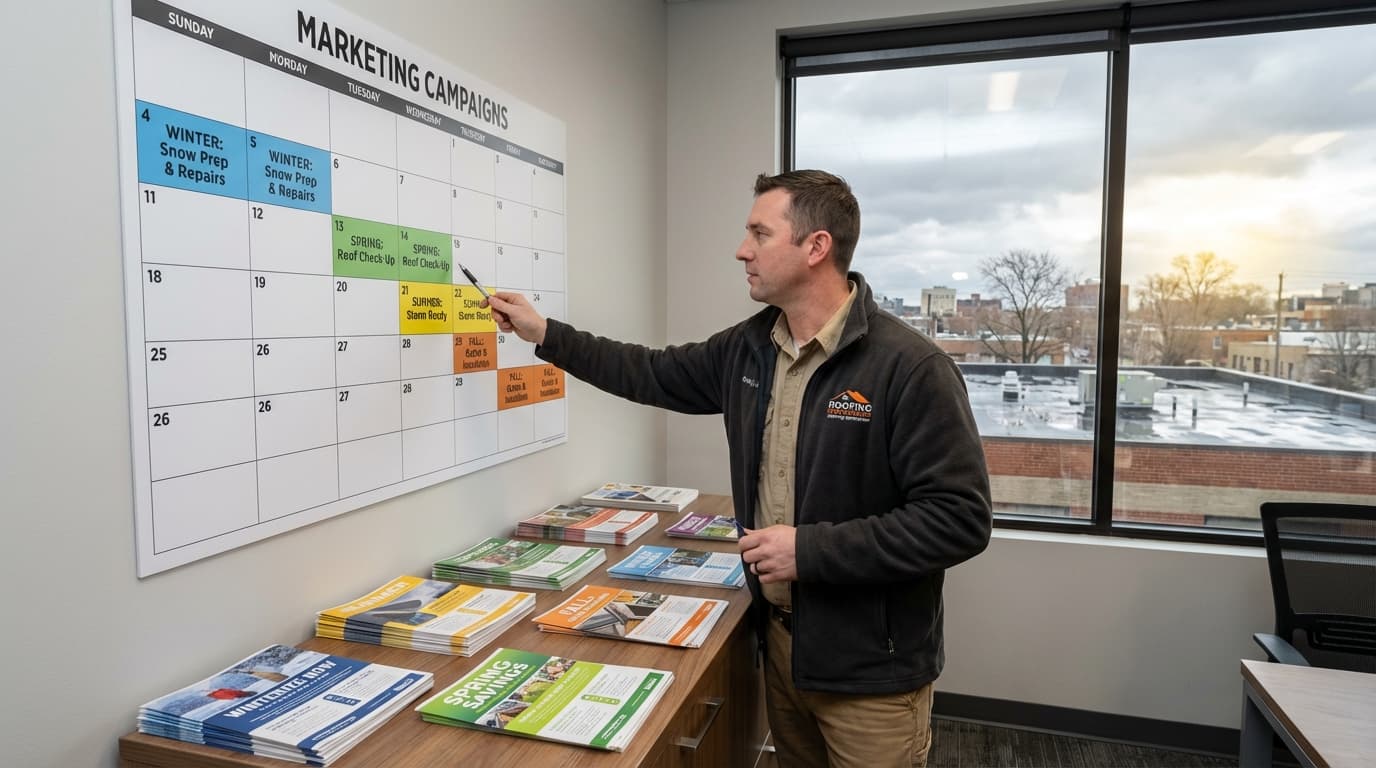
January hits and your phone stops ringing. After a busy fall, you're suddenly staring at an empty schedule, wondering how to keep crews busy until spring. Then storm season arrives, and you're drowning in more leads than you can handle—turning away work while competitors scoop up customers.
This feast-or-famine cycle isn't inevitable. It's a marketing problem with a marketing solution.
The roofing companies that maintain steady revenue year-round don't have different weather—they have different marketing strategies. They prepare for slow seasons months in advance and build capacity for peak demand before it arrives.
TL;DR: Successful roofing marketing requires a 12-month calendar with different strategies for each season. Slow season (winter) focuses on repairs, inspections, and commercial work. Pre-storm season builds awareness and pipeline. Storm season requires capacity for immediate response. Post-season nurtures unconverted leads. Companies following seasonal strategies report 40% more consistent monthly revenue and 25% higher annual totals.
Stop reacting to seasons. Start planning for them.
Understanding Roofing Seasonality
Different regions face different patterns, but all roofing businesses have cycles.
Regional Season Patterns
Northern markets (freeze/thaw regions):
| Season | Primary Work | Marketing Focus |
|---|---|---|
| Winter (Dec-Feb) | Interior, commercial, emergency repairs | Retention, planning, commercial |
| Spring (Mar-May) | Storm damage, inspections, replacements | Storm prep, spring campaigns |
| Summer (Jun-Aug) | Peak production, replacements | Capacity management, reviews |
| Fall (Sep-Nov) | Winterization, final replacements | Pre-winter push, maintenance |
Southern markets (hurricane/hail regions):
| Season | Primary Work | Marketing Focus |
|---|---|---|
| Winter (Dec-Feb) | Steady residential, commercial | Retail replacement focus |
| Spring (Mar-May) | Pre-storm prep, inspections | Storm prep awareness |
| Summer (Jun-Sep) | Storm season, emergency response | Storm response campaigns |
| Fall (Oct-Nov) | Storm recovery, catch-up | Long-term nurture |
Year-round markets (mild climates):
| Season | Primary Work | Marketing Focus |
|---|---|---|
| All year | Consistent demand | Competitive differentiation |
| Rainy season | Leak repairs, emergency | Urgency campaigns |
| Dry season | Replacements, improvements | Project-based marketing |
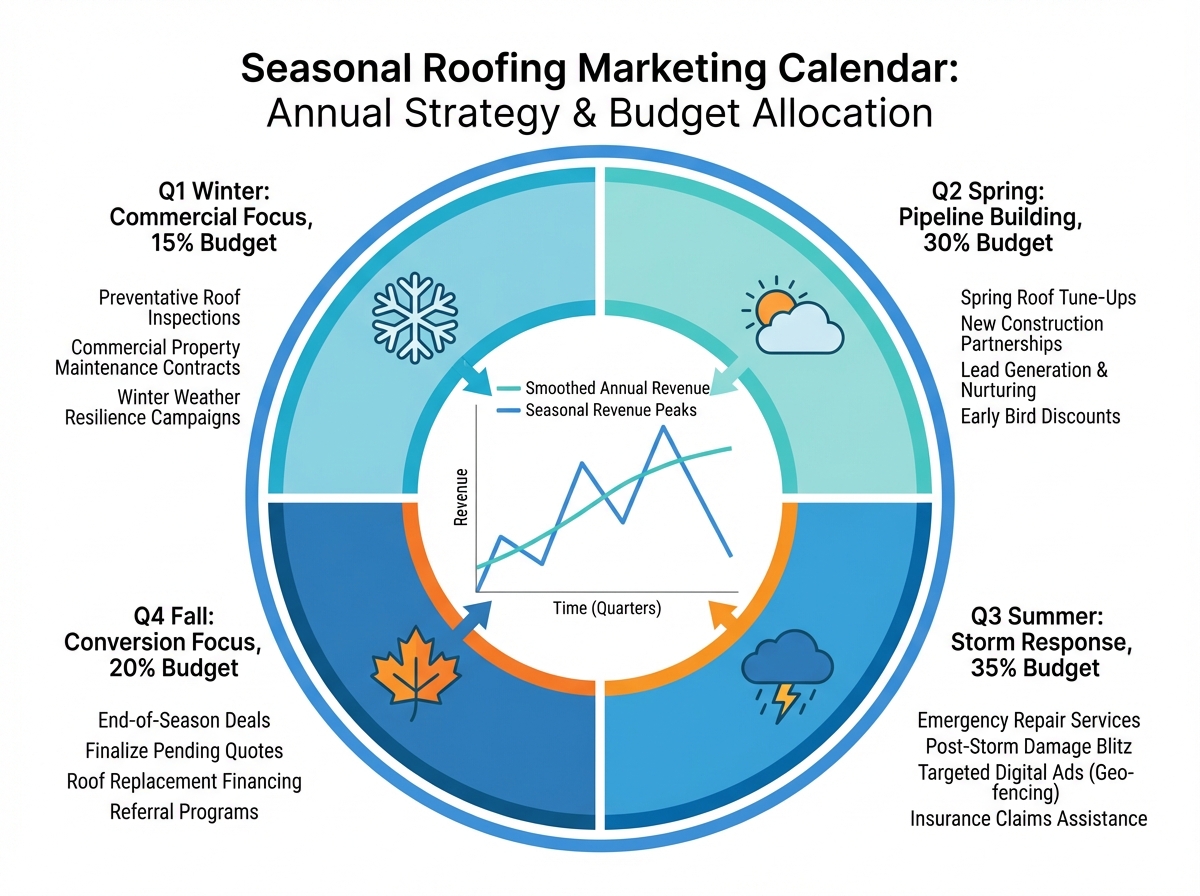
Building Your Seasonal Marketing Calendar
Plan campaigns 90 days in advance. Here's the framework.
Q1: Winter/Slow Season (January-March)
Primary challenge: Low demand, keeping crews working.
Marketing objectives:
- Generate repair and maintenance leads
- Build commercial pipeline
- Prepare spring campaigns
- Strengthen customer relationships
Campaigns to run:
| Campaign | Timing | Goal |
|---|---|---|
| Winter roof inspection | Jan | Generate repair leads |
| Commercial outreach | Jan-Feb | Build B2B pipeline |
| Past customer reactivation | Feb | Maintenance agreements |
| Spring booking incentives | Feb-Mar | Lock in early projects |
Budget allocation: 15-20% of annual marketing budget
Messaging themes:
- "Prevent spring leaks with winter inspection"
- "Book now for priority spring scheduling"
- "Ice dam prevention and repair"
- "Commercial roof maintenance programs"
Q2: Pre-Storm/Spring Season (April-June)
Primary challenge: Building pipeline before peak demand.
Marketing objectives:
- Generate replacement leads
- Build storm prep awareness
- Fill spring schedule
- Expand service area presence
Campaigns to run:
| Campaign | Timing | Goal |
|---|---|---|
| Storm prep awareness | Apr | Position for storm season |
| Spring replacement push | Apr-May | Generate estimates |
| Neighborhood canvassing | May-Jun | Local presence |
| Insurance education | May-Jun | Prepare homeowners |
Budget allocation: 25-30% of annual marketing budget
Messaging themes:
- "Is your roof ready for storm season?"
- "Free spring roof inspection"
- "Hail season is coming—schedule your assessment"
- "Finance your roof before storm damage"
Q3: Storm/Peak Season (July-September)
Primary challenge: Capacity management, lead quality.
Marketing objectives:
- Maintain visibility during high competition
- Convert storm damage leads quickly
- Maximize production efficiency
- Build reviews and reputation
Campaigns to run:
| Campaign | Timing | Goal |
|---|---|---|
| Storm response (reactive) | As needed | Immediate lead capture |
| Paid search maintenance | Ongoing | Maintain position |
| Review generation | Ongoing | Build reputation |
| Retargeting past leads | Ongoing | Convert fence-sitters |
Budget allocation: 35-40% of annual marketing budget
Messaging themes:
- "Storm damage? We're here to help."
- "Insurance claim specialists"
- "Same-week inspections available"
- "Trusted by [X] homeowners this season"
Q4: Post-Season/Fall (October-December)
Primary challenge: Converting remaining pipeline, planning ahead.
Marketing objectives:
- Close pending estimates
- Generate winterization leads
- Build next-year pipeline
- Retain seasonal staff
Campaigns to run:
| Campaign | Timing | Goal |
|---|---|---|
| End-of-year financing | Oct | Close pending deals |
| Winterization packages | Oct-Nov | Generate fall work |
| Holiday thank-you | Dec | Customer retention |
| Next-year planning | Nov-Dec | Internal preparation |
Budget allocation: 20-25% of annual marketing budget
Messaging themes:
- "Last chance for 2026 pricing"
- "Prepare your roof for winter"
- "Year-end financing specials"
- "Thank you for a great season"
Slow Season Marketing Strategies
Don't hibernate—hunt different prey.
Commercial Roofing Pivot
Why commercial works in winter:
- Building managers plan annual maintenance
- Budget cycles often align with calendar year
- Interior work possible regardless of weather
- Larger projects justify slower season
Commercial outreach tactics:
| Tactic | How to Execute |
|---|---|
| Property manager direct mail | Targeted list, maintenance focus |
| LinkedIn outreach | Connect with facility managers |
| Commercial inspection offers | Free assessment, relationship building |
| Referral partnerships | Commercial real estate agents |
Repair and Maintenance Focus
Winter repair opportunities:
- Ice dam damage
- Attic ventilation issues
- Flashing repairs
- Interior leak investigations
- Gutter maintenance
Marketing for repairs:
- Lower cost per lead (smaller jobs)
- Positions you for future replacement
- Keeps crews working
- Maintains cash flow
Past Customer Reactivation
Mine your database:
| Customer Segment | Offer | Timing |
|---|---|---|
| 5+ year old roofs | Free inspection | Jan-Feb |
| Past estimates (not closed) | Seasonal discount | Jan-Feb |
| Maintenance customers | Renewal incentive | Annual |
| Referral sources | Gift + referral ask | Jan |
Email reactivation sequence:
- "It's been a while" personal check-in
- Free inspection offer
- Limited-time incentive
- Final reminder before spring rush
Geographic Expansion
Use slow season to:
- Research new markets
- Build local partnerships
- Generate reviews in new areas
- Test advertising in adjacent territories
Storm Season Marketing Strategies
When storms hit, be ready.
Pre-Storm Preparation
Before storm season:
- Pre-build landing pages for storm response
- Prepare ad campaigns (ready to activate)
- Train team on storm lead handling
- Stock yard signs and door hangers
- Build canvassing team capacity
Prepared assets:
| Asset | Purpose | Status |
|---|---|---|
| Storm landing page | Capture urgent leads | Built, ready to launch |
| Google Ads campaigns | Quick activation | Paused, ready |
| Door hanger templates | Neighborhood outreach | Printed, stored |
| Social media posts | Community presence | Scheduled, queued |
| Email templates | Customer notification | Written, tested |
Rapid Response Marketing
When storm hits:
| Timeline | Action |
|---|---|
| 0-4 hours | Activate paid search campaigns |
| 0-24 hours | Social media storm response posts |
| 24-48 hours | Begin neighborhood canvassing |
| 48-72 hours | Direct mail to affected areas |
| 1 week | Follow-up on all storm leads |
Storm landing page elements:
- Clear "storm damage" headline
- Fast-track inspection form
- Phone number prominently displayed
- Insurance process explanation
- Trust signals (reviews, credentials)
Lead Qualification During High Volume
When leads exceed capacity:
| Priority | Criteria | Response |
|---|---|---|
| High | Replacement likely, insurance claim | Same-day callback |
| Medium | Repair possible, cash customer | 24-hour callback |
| Low | Tire-kicker, outside area | 48-hour callback |
Use lead scoring to prioritize:
- Property value
- Damage description
- Timeline urgency
- Previous customer relationship
Capacity Management
When demand exceeds supply:
- Raise prices (market-appropriate)
- Prioritize higher-margin work
- Subcontract strategically
- Extend timelines honestly
- Don't overpromise
Channel Strategies by Season
Different channels work better in different seasons.
Paid Search (Google Ads)
Seasonal adjustments:
| Season | Budget | Strategy |
|---|---|---|
| Winter | 50% of peak | Focus on repairs, commercial |
| Spring | 75% of peak | Ramp up for storm season |
| Summer/Storm | 100%+ | Maximum visibility |
| Fall | 75% of peak | Close rate optimization |
Keyword focus by season:
- Winter: "roof leak repair," "emergency roof repair"
- Spring: "roof inspection," "roof replacement estimate"
- Storm: "storm damage roof," "hail damage repair"
- Fall: "roof winterization," "last minute roof replacement"
Social Media
Seasonal content calendar:
| Season | Content Type | Frequency |
|---|---|---|
| Winter | Educational, behind-scenes | 2-3x/week |
| Spring | Before/after, storm prep | 3-4x/week |
| Summer | Project showcases, reviews | 4-5x/week |
| Fall | Winterization tips, testimonials | 2-3x/week |
Email Marketing
Seasonal email campaigns:
| Campaign | Timing | Audience |
|---|---|---|
| Winter inspection | January | All past customers |
| Storm prep | 4-6 weeks before season | All contacts |
| Post-storm check-in | After major storms | Affected areas |
| End-of-year push | November | Open estimates |
Direct Mail
When direct mail works:
- Slow season reactivation
- Post-storm neighborhood saturation
- New service area introduction
- High-value neighborhood targeting
Budget Allocation Framework
Distribute marketing spend strategically across the year.
Annual Budget Distribution
For a $60,000 annual marketing budget:
| Quarter | Allocation | Amount | Focus |
|---|---|---|---|
| Q1 (Jan-Mar) | 15% | $9,000 | Retention, commercial |
| Q2 (Apr-Jun) | 30% | $18,000 | Pipeline building |
| Q3 (Jul-Sep) | 35% | $21,000 | Storm response |
| Q4 (Oct-Dec) | 20% | $12,000 | Conversion, planning |
Channel Budget by Season
Q1 (slow season):
- Email marketing: 30%
- Direct mail (commercial): 25%
- Google Ads (repairs): 25%
- Social media: 20%
Q2 (pre-storm):
- Google Ads: 40%
- Facebook Ads: 25%
- Content marketing: 20%
- Direct mail: 15%
Q3 (storm season):
- Google Ads: 45%
- LSA: 25%
- Canvassing/door hangers: 20%
- Social media: 10%
Q4 (post-season):
- Email (follow-up): 35%
- Google Ads: 30%
- Retargeting: 25%
- Direct mail: 10%
Measuring Seasonal Performance
Track metrics that account for seasonality.
Year-Over-Year Comparison
Compare same periods:
- January 2026 vs. January 2025 (not December 2025)
- Q3 2026 vs. Q3 2025
- Storm week vs. previous storm week
Track:
- Lead volume by month
- Cost per lead by month
- Conversion rate by month
- Revenue by month
Seasonal Benchmarks
Set different targets by season:
| Metric | Winter | Spring | Summer | Fall |
|---|---|---|---|---|
| Leads/month | 20-40 | 50-80 | 80-150 | 40-70 |
| Cost per lead | $60-100 | $40-70 | $30-60 | $50-80 |
| Close rate | 30-40% | 35-45% | 25-35% | 30-40% |
Attribution Across Seasons
Long sales cycles require patience:
- Spring marketing may convert in summer
- Storm leads may close in fall
- Track lead source to close, not just lead source
Frequently Asked Questions
How do I keep crews busy during slow season?
Three strategies: (1) Pivot to commercial work with different decision timelines, (2) Focus on repairs and maintenance that homeowners defer during busy season, (3) Use slow periods for training, equipment maintenance, and business development. Some companies offer crews reduced hours with guaranteed spring employment rather than layoffs.
Should I lower prices during slow season?
Modest seasonal discounts (10-15%) can generate volume without destroying margins. Position as "early booking discount" or "winter special" rather than desperation pricing. Never discount more than you need to—some customers will pay full price regardless of season. Track whether discounted work converts to referrals and reviews.
How far ahead should I plan seasonal campaigns?
Plan 90 days ahead minimum. Q3 storm campaigns should be built and ready by June. Q1 commercial outreach should be planned in October. The companies that win each season start preparing while competitors are still reacting to the previous one.
Build Your Year-Round Marketing Engine
Seasonal success requires year-round planning. The roofing companies that maintain consistent revenue don't fight seasonality—they leverage it. Each season has opportunities; you just need different strategies to capture them.
Key takeaways:
- Plan campaigns 90 days in advance
- Allocate more budget to peak seasons, but don't abandon slow periods
- Pivot messaging and channels by season
- Use slow season for commercial, repairs, and relationship building
- Pre-build storm response assets before you need them
- Compare performance year-over-year, not month-over-month
The goal isn't to eliminate seasonality—it's to smooth the revenue curve and maximize each season's potential.
Ready to track seasonal marketing performance? Start your free trial with TruLine and see marketing ROI by season and channel.