You started your plumbing business to be your own boss. Now you're working 70-hour weeks, answering emergency calls at midnight, and wondering if growth means more freedom or just more chaos.
The plumbing companies that scale successfully don't just work harder—they work differently. They build systems that generate revenue without requiring the owner to be on every call. They create recurring revenue that smooths out seasonal swings. They hire people who can deliver quality without constant supervision.
TL;DR: Plumbing businesses typically plateau at $500K-$750K when the owner becomes the bottleneck. Breaking through requires three shifts: building recurring revenue through service agreements (targeting 30%+ of revenue), systematizing operations so others can deliver consistent quality, and strategic hiring that expands capacity without proportionally increasing overhead. Most successful growth comes from selling more to existing customers, not just finding new ones.
The path from one-truck operation to multi-million dollar company is well-traveled. Here's the roadmap.
The Plumbing Business Growth Stages
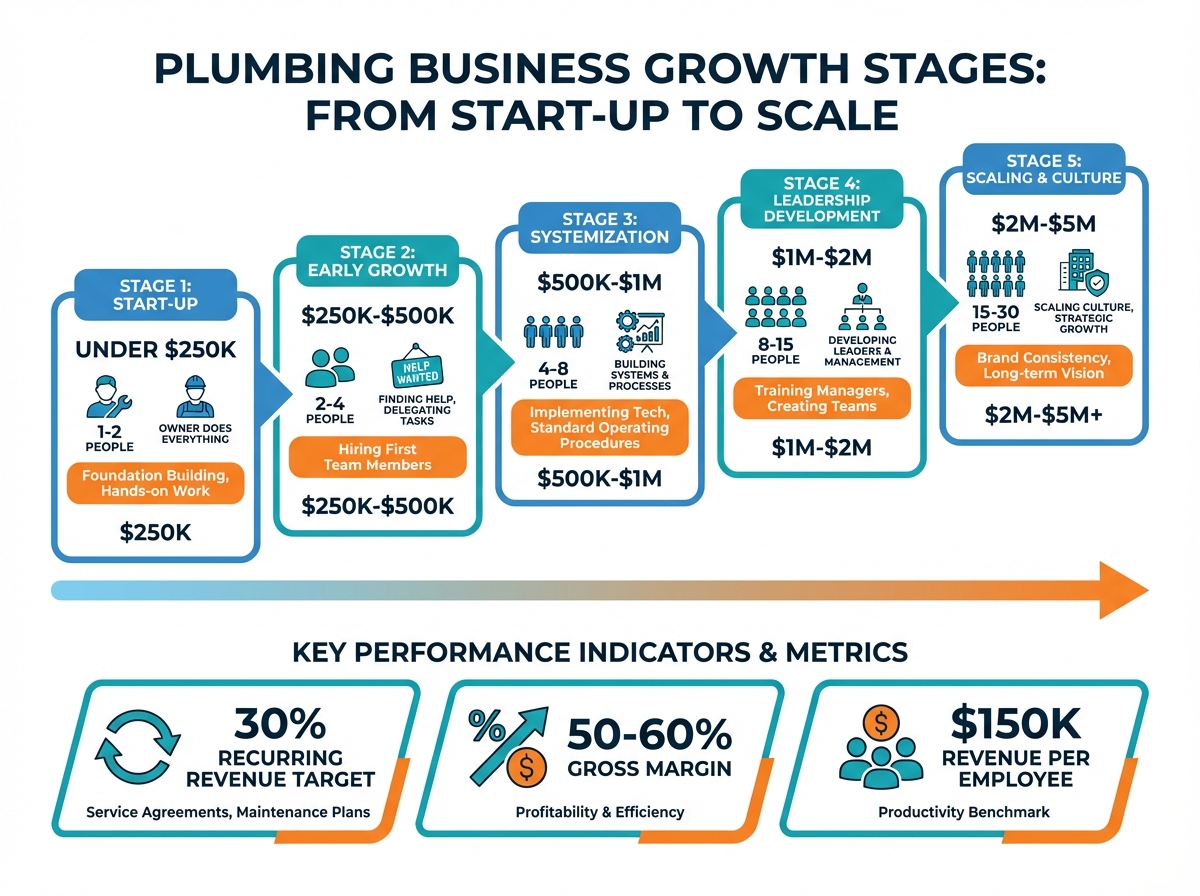
Different revenue levels face different challenges. Recognize where you are.
Growth stage characteristics:
| Revenue | Team Size | Owner Role | Primary Challenge |
|---|---|---|---|
| Under $250K | 1-2 | Does everything | Getting enough leads |
| $250K-$500K | 2-4 | Primary technician | Finding reliable help |
| $500K-$1M | 4-8 | Working manager | Building systems |
| $1M-$2M | 8-15 | Full-time manager | Developing leaders |
| $2M-$5M | 15-30 | Executive | Scaling culture |
| $5M+ | 30+ | CEO/visionary | Market expansion |
The common plateau:
Most plumbing businesses stall between $500K and $750K. This is where:
- The owner can't do more work personally
- Hiring feels risky and expensive
- Systems don't exist to maintain quality without owner involvement
- Marketing brings leads that can't be serviced
Breaking through this plateau requires different thinking, not just harder work.
Strategy 1: Build Recurring Revenue with Service Agreements
The most profitable plumbing companies have 30-50% of revenue from recurring sources.
Why Recurring Revenue Matters
Comparison: Project-only vs. recurring revenue model:
| Metric | Project Only | 30% Recurring |
|---|---|---|
| January revenue | $28,000 | $45,000 |
| Revenue predictability | Low | High |
| Customer lifetime value | $450 | $2,800 |
| Marketing cost per job | $85 | $35 |
| Cash flow stability | Volatile | Steady |
Recurring revenue transforms your business from hunting (finding new customers constantly) to farming (nurturing relationships that produce repeatedly).
Plumbing Service Agreement Structure
Basic maintenance agreement:
- Annual drain inspection
- Water heater flush
- Fixture check and adjustment
- Priority scheduling
- Discount on repairs (10-15%)
- Price: $99-149/year
Premium agreement:
- Everything in basic
- Semi-annual visits
- Water quality testing
- Leak detection inspection
- Emergency priority (same-day)
- Larger repair discount (15-20%)
- Price: $199-299/year
Selling Service Agreements
When to offer:
- After completing any service call (highest conversion)
- During water heater installations
- When finding minor issues that will need future attention
- Seasonal outreach to past customers
Script example:
"I noticed your water heater is about 8 years old—they typically last 10-12 years. Our maintenance plan includes annual water heater flushing, which extends the life by 2-3 years. Plus you get priority scheduling and 15% off any repairs. It's $149 for the year. Would you like me to add that to today's service?"
Conversion targets:
- Post-service offer: 20-30% conversion
- Water heater installation: 40-50% conversion
- Seasonal outreach: 5-10% conversion
Service Agreement Math
Building to 500 agreements:
| Year | New Agreements | Total Active | Annual Revenue |
|---|---|---|---|
| Year 1 | 150 | 150 | $22,500 |
| Year 2 | 175 | 290 | $43,500 |
| Year 3 | 200 | 435 | $65,250 |
| Year 4 | 225 | 580 | $87,000 |
| Year 5 | 250 | 720 | $108,000 |
Assumes $150 average agreement, 15% annual churn
Beyond agreement revenue:
- Agreement customers call you first for all plumbing needs
- Average 2.3 additional service calls per year
- Higher close rate on recommendations
- Referral source for new customers
Strategy 2: Optimize Your Pricing
Most plumbers underprice their services. Strategic pricing drives growth without adding customers.
Flat-Rate vs. Time-and-Materials
Time-and-materials problems:
- Customers fear runaway costs
- Efficient technicians earn less
- Hard to predict revenue
- Difficult to train pricing consistency
Flat-rate benefits:
- Customer knows cost upfront
- Rewards efficiency
- Predictable margins
- Easier for new technicians
Flat-rate implementation:
- Track actual time and materials for 100+ common jobs
- Build pricebook with standard rates
- Include 20-30% margin buffer for variations
- Train technicians on presentation
Good-Better-Best Pricing
Always offer three options:
| Option | Description | Margin | Selection Rate |
|---|---|---|---|
| Good | Basic fix, minimum warranty | 30% | 25% |
| Better | Quality parts, standard warranty | 40% | 55% |
| Best | Premium, extended warranty, extras | 50% | 20% |
Example: Toilet replacement
| Option | Includes | Price |
|---|---|---|
| Good | Builder-grade toilet, 1-year warranty | $375 |
| Better | Mid-grade toilet, soft-close seat, 2-year warranty | $525 |
| Best | High-efficiency toilet, bidet seat, 5-year warranty | $895 |
Most customers choose "Better"—which should be your target margin option.
Price Increase Strategy
Annual increases are essential:
- Costs rise 3-5% annually minimum
- If you don't raise prices, you're taking a pay cut
- Customers expect modest annual increases
How to raise prices:
- Announce in advance: "Starting March 1, our rates will increase to reflect rising costs"
- Frame the value: "We've invested in new equipment and training to serve you better"
- Grandfather agreements: Existing service agreement customers keep current rates for their contract term
- Raise strategically: Larger increases on high-demand services, smaller on competitive ones
Target: 5-8% annual price increase across your pricebook.
Strategy 3: Systematize Operations
Growth requires your business to function without you doing everything.
Document Your Processes
Critical processes to document:
- Call handling and dispatch
- Technician arrival procedure
- Diagnostic process
- Option presentation
- Payment collection
- Follow-up sequence
Documentation format:
- Step-by-step checklist
- Scripts for customer interactions
- Decision trees for common situations
- Quality standards and exceptions
Technology for Systemization
Essential software stack:
| Function | Tool | Investment |
|---|---|---|
| CRM/Lead management | TruLine, ServiceTitan | $100-300/user/mo |
| Scheduling/Dispatch | Same as above or Housecall Pro | $50-150/mo |
| Accounting | QuickBooks | $30-80/mo |
| Call tracking | CallRail | $45-100/mo |
| Communication | Company texting platform | $25-50/mo |
Quality Control Systems
Ensure consistent quality without owner inspection:
| Control | Method | Frequency |
|---|---|---|
| Photo documentation | Required before/after photos | Every job |
| Customer surveys | Automatic post-service | Every job |
| Ride-alongs | Supervisor accompanies tech | Monthly per tech |
| Call recordings | Review sample calls | Weekly |
| Callback tracking | Monitor repeat visits | Weekly report |
Quality metrics to track:
- Customer satisfaction score (target: 4.5+/5)
- Callback rate (target: under 3%)
- Average ticket (track by technician)
- Conversion rate (track by technician)
Strategy 4: Strategic Hiring and Team Development
Growth requires people. The right hiring approach makes or breaks scaling.
When to Hire
Hire when:
- Turning away work regularly
- Response times slipping
- Customer satisfaction declining
- Owner working unsustainable hours
- Seasonal peaks causing chaos
Don't hire when:
- Hoping new person will "find" work
- Can't articulate what they'll do
- Don't have training capacity
- Cash flow is tight
The Hiring Funnel
For one good plumber, expect:
- 50 applications
- 15 phone screens
- 7 in-person interviews
- 3 working interviews
- 1 hire
Never hire out of desperation. A bad hire costs 3-6 months of salary in lost productivity, training, and potential damage.
Compensation Structures
Common models:
| Model | Pros | Cons |
|---|---|---|
| Hourly | Simple, predictable cost | No incentive for efficiency |
| Salary | Stability for employee | Same productivity issues |
| Commission on sales | Motivates upselling | Can feel pushy to customers |
| Performance bonus | Rewards results | Complex to track |
| Hybrid | Balances stability and incentive | Requires good systems |
Recommended hybrid approach:
- Base salary/hourly for stability
- Monthly bonus based on: revenue generated, customer satisfaction, callbacks
- Annual bonus tied to company performance
Training Program
New hire training sequence:
| Week | Focus | Activities |
|---|---|---|
| 1 | Company and culture | Policies, software, ride-alongs |
| 2 | Technical basics | Shadow experienced tech, supervised work |
| 3-4 | Customer interaction | Scripts, role-play, supervised calls |
| 5-8 | Supervised independence | Solo work with daily check-ins |
| 9+ | Full independence | Weekly coaching, ongoing training |
Strategy 5: Marketing for Growth
Marketing changes as you grow. What worked at $250K won't work at $2M.
Marketing Budget by Stage
| Revenue | Marketing Budget | Focus |
|---|---|---|
| Under $500K | 8-12% of revenue | Lead generation |
| $500K-$1M | 6-10% of revenue | Brand + leads |
| $1M-$2M | 5-8% of revenue | Diversified channels |
| $2M+ | 4-6% of revenue | Brand dominance |
Channel Priority by Stage
Early stage ($250K-$500K):
- Google Business Profile optimization
- Google Local Services Ads
- Customer referral program
- Review generation
Growth stage ($500K-$1M):
- All early stage channels
- Google Ads (search)
- SEO/content marketing
- Facebook retargeting
Scale stage ($1M+):
- All previous channels
- Brand advertising
- Community involvement
- Strategic partnerships
The Referral Engine
Best plumbing leads come from referrals:
- Lower cost per acquisition
- Higher close rate
- Better customer lifetime value
- Faster trust building
Building a referral system:
- Ask at the right time: After successfully completing a job, not during
- Make it easy: "Know anyone who might need plumbing help? I'll take great care of them."
- Reward referrers: $25-50 credit toward future service
- Track and thank: Follow up when referral becomes customer
Strategy 6: Financial Management for Growth
Growth requires cash. Manage finances proactively.
Cash Flow Management
The growth cash crunch:
- Hiring requires investment before revenue
- Marketing spend precedes results
- Inventory ties up cash
- Receivables slow during growth
Cash flow tactics:
- Collect payment at time of service (not invoicing)
- Require deposits on large jobs
- Finance equipment instead of buying outright
- Build 2-3 months operating expenses in reserve
Key Financial Metrics
Track monthly:
| Metric | Target | Why It Matters |
|---|---|---|
| Gross margin | 50-60% | Room for overhead and profit |
| Net profit | 10-20% | Business health |
| Revenue per employee | $150K+ | Productivity |
| Revenue per truck | $250K+ | Asset utilization |
| Accounts receivable days | Under 15 | Cash flow |
Financing Growth
Options for funding expansion:
| Source | Best For | Considerations |
|---|---|---|
| Retained earnings | Slow, steady growth | Safest, no debt |
| Line of credit | Seasonal cash flow | Interest cost |
| Equipment financing | Trucks, tools | Preserves cash |
| SBA loan | Major expansion | Process is slow |
Common Growth Mistakes
Learn from others' failures.
Mistake 1: Growing Without Systems
Problem: Adding trucks before you can manage them.
Result: Quality drops, callbacks increase, reputation suffers, growth reverses.
Solution: Build systems first. Document processes, implement software, prove they work, then add capacity.
Mistake 2: Underpricing to Win Work
Problem: Competing on price to get busy.
Result: Busy but not profitable. No money to hire, train, or market.
Solution: Compete on value, not price. Customers who choose the cheapest aren't customers you want.
Mistake 3: Owner as Only Salesperson
Problem: Only the owner can close big jobs.
Result: Growth limited by owner's time. Burnout inevitable.
Solution: Train technicians to present options. Systematize the sales process. Hire a dedicated salesperson when volume justifies it.
Mistake 4: Ignoring Customer Lifetime Value
Problem: Treating every job as a one-time transaction.
Result: High marketing costs, low retention, inconsistent revenue.
Solution: Track CLV by customer. Invest in service agreements. Follow up systematically. Build your CRM around relationships.
Mistake 5: Hiring Friends and Family
Problem: Avoiding difficult performance conversations.
Result: Underperformers drag down the team. Resentment builds.
Solution: Hire based on qualifications. If you do hire family, establish clear expectations and accountability from day one.
Growth Action Plan
Prioritize based on your current stage:
Under $500K: Foundation Building
| Priority | Action | Timeline |
|---|---|---|
| 1 | Implement flat-rate pricing | Month 1 |
| 2 | Start service agreement program | Month 2 |
| 3 | Set up CRM and lead tracking | Month 2-3 |
| 4 | Document core processes | Month 3-4 |
| 5 | Optimize Google Business Profile | Month 1 |
$500K-$1M: Scaling Systems
| Priority | Action | Timeline |
|---|---|---|
| 1 | Hire and train additional tech | Quarter 1 |
| 2 | Implement full software stack | Quarter 1 |
| 3 | Build 300+ service agreements | Year 1 |
| 4 | Launch Google Ads | Quarter 2 |
| 5 | Develop technician training program | Quarter 2-3 |
$1M-$2M: Building Leadership
| Priority | Action | Timeline |
|---|---|---|
| 1 | Hire operations manager | Quarter 1 |
| 2 | Implement performance-based comp | Quarter 1-2 |
| 3 | Build to 500+ service agreements | Year 1 |
| 4 | Diversify marketing channels | Ongoing |
| 5 | Develop team lead/supervisor roles | Quarter 2-4 |
Frequently Asked Questions
How fast should I try to grow?
Sustainable growth for most plumbing businesses is 20-40% annually. Faster growth is possible but risky—quality often suffers, cash gets tight, and culture erodes. Growing 30% per year doubles your business in under three years. That's fast enough.
When should I add my first employee?
When you're consistently turning away work or working unsustainable hours for more than 3-4 months. Have cash reserves to cover 3 months of their salary before they're fully productive. Start with a helper/apprentice before hiring a licensed plumber—lower risk, lower cost, and you can train them your way.
Should I expand services or geography first?
Usually services. Adding drain cleaning, water heater installation, or fixture work to your core offerings lets you sell more to existing customers. Geographic expansion requires marketing in new areas, building reputation from scratch, and longer drive times. Master your current market before expanding territory.
Build Your Growth Engine
Plumbing business growth isn't about working harder—it's about working strategically. The owners who break through the $500K-$750K plateau do so by building systems, creating recurring revenue, and developing teams that can deliver quality without constant supervision.
Key takeaways:
- Build recurring revenue to 30%+ through service agreements
- Implement flat-rate, good-better-best pricing
- Document and systematize before scaling
- Hire strategically, train thoroughly
- Track metrics that matter: margin, CLV, revenue per employee
The path from one truck to a fleet is well-worn. The plumbers who make it aren't necessarily better technicians—they're better business builders.
Your next step depends on where you are today. Pick one strategy from this guide and implement it fully before moving to the next. Consistent execution beats sporadic effort every time.
Ready to track your growth metrics and manage leads systematically? Start your free trial with TruLine and build the foundation for scalable growth.