January arrives. Your phone goes quiet. After a busy December, you're staring at an empty schedule, wondering how you'll make payroll. You scramble for leads, drop prices, and stress about survival until spring.
Meanwhile, your competitor down the street has 400 maintenance agreements generating $45,000 every month—whether the phone rings or not.
That's the difference between transactional and recurring revenue. One business lives call-to-call; the other has predictable income that smooths seasonality and funds growth.
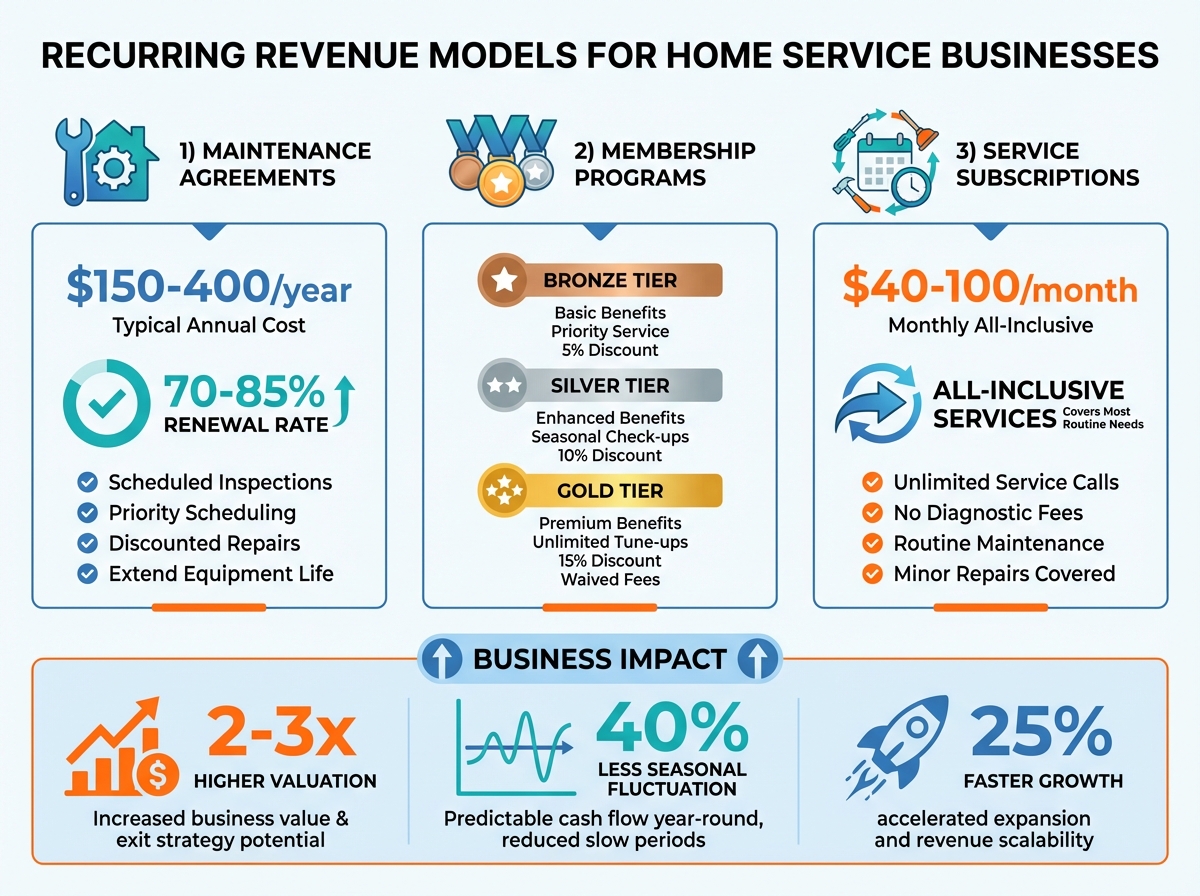
TL;DR: Recurring revenue from maintenance agreements and membership programs transforms home service businesses. Companies with 30%+ recurring revenue sell for 2-3x higher multiples, experience 40% less seasonal fluctuation, and grow 25% faster. The key is building a systematic program with clear value, easy enrollment, high retention, and consistent delivery. Most contractors leave millions in lifetime revenue on the table by not prioritizing recurring relationships.
Building recurring revenue isn't just smart business—it's the difference between owning a job and owning a valuable company.
Why Recurring Revenue Matters
Recurring revenue fundamentally changes your business economics.
The Valuation Impact
Business value comparison:
| Business Type | Revenue | Valuation Multiple | Business Value |
|---|---|---|---|
| 100% transactional | $2M | 0.5-0.7x | $1.0-1.4M |
| 20% recurring | $2M | 0.8-1.2x | $1.6-2.4M |
| 40% recurring | $2M | 1.5-2.5x | $3.0-5.0M |
Why buyers pay more for recurring revenue:
- Predictable cash flow reduces risk
- Customer relationships transfer with sale
- Easier to forecast and grow
- Lower customer acquisition costs
- Built-in upsell opportunities
The Stability Impact
Seasonal revenue smoothing:
| Month | Transactional Only | With 40% Recurring |
|---|---|---|
| January | $80,000 | $140,000 |
| February | $75,000 | $135,000 |
| July | $200,000 | $220,000 |
| August | $210,000 | $230,000 |
| Annual variance | 180% | 70% |
Recurring revenue benefits:
- Consistent cash flow for payroll
- Confidence to hire and invest
- Less desperation pricing in slow months
- Better negotiating position with suppliers
The Growth Impact
Recurring revenue accelerates growth:
| Factor | Why It Helps Growth |
|---|---|
| Predictable base | Plan investments confidently |
| Lower CAC | Existing customers cost less to serve |
| Higher LTV | Longer relationships, more services |
| Referral source | Happy members refer more |
| Capacity planning | Know demand in advance |
Types of Recurring Revenue for Contractors
Multiple models work for home services.
Maintenance Agreements
The foundation of contractor recurring revenue.
| Element | Description |
|---|---|
| What it is | Annual contract for scheduled maintenance |
| Typical price | $150-400/year residential |
| What's included | 1-2 tune-ups, priority scheduling, discounts |
| Renewal rate | 70-85% with good programs |
Maintenance agreement benefits:
| For Customer | For Contractor |
|---|---|
| Prevents breakdowns | Predictable revenue |
| Priority service | Scheduled workflow |
| Repair discounts | Upsell opportunities |
| Peace of mind | Customer retention |
| Extended equipment life | Higher lifetime value |
Membership Programs
Enhanced version of maintenance agreements.
| Element | Description |
|---|---|
| What it is | Tiered program with escalating benefits |
| Typical pricing | $15-50/month or $150-500/year |
| What's included | Maintenance + perks + priority + discounts |
| Positioning | "Club" or "VIP" membership |
Membership tier example:
| Tier | Price | Includes |
|---|---|---|
| Bronze | $15/month | 1 tune-up, 10% discount, priority |
| Silver | $25/month | 2 tune-ups, 15% discount, priority, free diagnostics |
| Gold | $40/month | 2 tune-ups, 20% discount, same-day priority, free diagnostics, no trip fees |
Service Subscriptions
All-inclusive protection plans.
| Element | Description |
|---|---|
| What it is | Monthly fee covers maintenance AND repairs |
| Typical pricing | $40-100/month |
| What's included | All maintenance, covered repairs, replacements |
| Risk model | Contractor assumes equipment risk |
Subscription considerations:
| Advantage | Challenge |
|---|---|
| Higher monthly revenue | Repair cost risk |
| Stronger customer lock-in | Requires actuarial thinking |
| Competitor differentiation | Higher price point |
| Simplified customer decision | Complex to administer |
Monitoring Services
Technology-enabled recurring revenue.
| Element | Description |
|---|---|
| What it is | Remote equipment monitoring with alerts |
| Typical pricing | $10-30/month |
| What's included | 24/7 monitoring, alerts, diagnostics |
| Technology | Smart thermostats, sensors, IoT devices |
Monitoring benefits:
- Detect problems before failure
- Proactive service calls
- Customer peace of mind
- Differentiation from competitors
Building Your Maintenance Agreement Program
Start with the foundation: a solid maintenance agreement program.
Pricing Your Agreements
Pricing methodology:
| Component | Calculation |
|---|---|
| Direct cost | Tech time + travel + materials |
| Overhead allocation | % of office costs |
| Target margin | 40-60% gross margin |
| Market positioning | Competitor comparison |
Pricing example (HVAC):
| Cost Element | Amount |
|---|---|
| Tech time (2 hours × 2 visits) | $120 |
| Travel | $30 |
| Materials (filters, etc.) | $25 |
| Total direct cost | $175 |
| Overhead (30%) | $52 |
| Target margin (50%) | $227 |
| Suggested price | $199-249/year |
Price positioning:
| Position | Price Point | Strategy |
|---|---|---|
| Budget | $149 | Volume-focused, minimal perks |
| Standard | $199 | Balanced value and margin |
| Premium | $299 | Maximum perks, highest margin |
Defining Agreement Benefits
Core benefits to include:
| Benefit | Value to Customer | Cost to You |
|---|---|---|
| Scheduled tune-ups | Prevents breakdowns | Direct labor |
| Priority scheduling | Faster service | Scheduling flexibility |
| Repair discount (15-20%) | Saves money | Margin reduction |
| No overtime charges | Predictable pricing | Revenue reduction |
| Extended parts warranty | Peace of mind | Minimal |
Premium benefits to consider:
| Benefit | When to Include | Impact |
|---|---|---|
| Free diagnostic fees | Premium tiers | High perceived value |
| No trip charges | Premium tiers | Strong retention driver |
| Same-day guarantee | Premium tiers | Competitive differentiator |
| Annual equipment credit | Premium tiers | Replacement incentive |
| Transferable to new owner | All tiers | Selling point |
Creating Compelling Offers
Agreement naming matters:
| Approach | Example | Psychology |
|---|---|---|
| Protection-focused | "Comfort Shield Plan" | Safety, security |
| Membership-focused | "Priority Club" | Exclusivity, belonging |
| Value-focused | "Smart Saver Program" | Financial benefit |
| Premium-focused | "Gold Service Membership" | Status, quality |
Offer presentation:
| Element | Best Practice |
|---|---|
| Price framing | Monthly: "$16.58/month" vs. annual: "$199/year" |
| Value stacking | List all benefits with dollar values |
| Risk reversal | "Cancel anytime" or satisfaction guarantee |
| Urgency | "Enroll today, get first tune-up free" |
| Social proof | "Join 500+ homeowners who..." |
Selling Maintenance Agreements
The best program fails if you can't enroll customers.
When to Sell Agreements
Optimal selling moments:
| Moment | Conversion Rate | Why It Works |
|---|---|---|
| After completed repair | 35-45% | Gratitude, fresh experience |
| During equipment install | 60-80% | Natural bundle |
| Seasonal tune-up | 25-35% | Relevant timing |
| After emergency call | 40-50% | "Never again" motivation |
| Annual renewal time | 70-85% | Existing relationship |
Sales Scripts That Work
Post-repair enrollment script:
"Now that we've got your [system] running great, I want to make sure it stays that way. Our Comfort Club membership includes two annual tune-ups—which alone are worth $198—plus priority scheduling if anything ever goes wrong, and 15% off any repairs.
It's $199 for the year, which works out to about $16 a month. Most of our customers sign up because they'd rather prevent problems than deal with emergencies. Should I get you enrolled today?"
Installation enrollment script:
"Congratulations on your new [system]! To protect your investment, we include our Comfort Club membership for the first year at no charge. You'll get two professional tune-ups to keep everything running at peak efficiency, priority scheduling, and 15% off any service.
After the first year, it's just $199 to continue. Most customers keep it because the tune-ups alone are worth more than that. Sound good?"
Handling Objections
Common objections and responses:
| Objection | Response |
|---|---|
| "I don't need it" | "Most people feel that way until they have an emergency on the coldest night of the year. This is really about peace of mind and priority access when you need us most." |
| "It's too expensive" | "I understand. Let me break it down—two tune-ups alone would cost $198 if you called separately. The membership also includes [list benefits]. It actually saves you money while giving you priority access." |
| "I'll think about it" | "Of course. Just so you know, if you enroll today, we can schedule your first tune-up before you leave. When would work better for you—mornings or afternoons?" |
| "I can do maintenance myself" | "That's great that you're handy. Our technicians do check things you can't easily access—refrigerant levels, electrical connections, heat exchanger integrity. It's really about the professional inspection and the priority service when you need us." |
Team Training for Agreement Sales
Training focus areas:
| Area | What to Cover |
|---|---|
| Belief | Why agreements benefit customers genuinely |
| Timing | When and how to introduce |
| Language | Specific scripts and phrases |
| Objections | Responses to common pushback |
| Process | How to enroll (paperwork, system) |
Compensation for agreement sales:
| Model | Amount | When to Use |
|---|---|---|
| Per-agreement bonus | $20-50 | Starting out, building behavior |
| Percentage of first year | 10-20% | Aligns with revenue |
| Tiered bonus | $25/$35/$50 | Rewards volume |
| Team goal bonus | $500 at 50 agreements | Builds teamwork |
Retention: Keeping Agreement Customers
Enrollment is half the battle—retention is the other half.
Retention Benchmarks
Industry retention rates:
| Performance Level | Retention Rate | Characteristic |
|---|---|---|
| Poor | <65% | No systematic approach |
| Average | 65-75% | Basic follow-up |
| Good | 75-85% | Proactive retention |
| Excellent | 85%+ | Systematic value delivery |
Retention economics:
| Scenario | Year 1 | Year 2 | Year 3 | Year 4 | Year 5 | Total |
|---|---|---|---|---|---|---|
| 65% retention | 100 | 65 | 42 | 27 | 18 | 252 |
| 85% retention | 100 | 85 | 72 | 61 | 52 | 370 |
| Difference | - | +20 | +30 | +34 | +34 | +118 |
At $200/agreement, that's $23,600 more revenue from the same 100 customers.
Proactive Retention Tactics
Throughout the year:
| Timing | Action | Purpose |
|---|---|---|
| Post-enrollment | Welcome email + call | Set expectations |
| Before tune-up | Reminder + scheduling | Ensure completion |
| After tune-up | Summary + recommendations | Demonstrate value |
| Mid-year | Check-in email | Stay top-of-mind |
| 60 days before renewal | First renewal notice | Early commitment |
| 30 days before | Second notice + incentive | Create urgency |
| At expiration | Final attempt + call | Personal touch |
Renewal Campaign Sequence
60-day renewal campaign:
| Day | Channel | Message |
|---|---|---|
| -60 | "Your membership renews soon—here's what you've received" | |
| -45 | Call | Personal renewal call with value recap |
| -30 | Email + Mail | Renewal notice with early-bird incentive |
| -14 | Text | "Quick reminder about your membership" |
| -7 | Call | Final call for non-renewals |
| 0 | "Last chance to maintain your benefits" |
Measuring Retention Drivers
Track what affects retention:
| Factor | Impact on Retention |
|---|---|
| Tune-up completion | +15-20% if both completed |
| Repair experience | +10-15% if positive |
| Response time | +5-10% if consistently fast |
| Technician quality | +10-15% if highly rated |
| Communication | +5-10% if proactive |
Scaling Your Recurring Revenue
Once the foundation is solid, scale systematically.
Growth Targets
Healthy recurring revenue trajectory:
| Year | Agreements | Recurring Revenue | % of Total |
|---|---|---|---|
| 1 | 150 | $30,000 | 8% |
| 2 | 350 | $70,000 | 15% |
| 3 | 600 | $120,000 | 22% |
| 4 | 900 | $180,000 | 28% |
| 5 | 1,200 | $240,000 | 35% |
Expansion Strategies
Growing agreement count:
| Strategy | Expected Growth |
|---|---|
| Post-service enrollment | 15-25 agreements/month |
| Installation bundles | 80%+ of installs |
| Acquisition campaigns | 5-10/month from marketing |
| Referral program | 5-10/month from members |
| Win-back campaigns | 10-20% of lapsed |
Upselling Agreement Customers
Agreement customers are your best prospects:
| Opportunity | Approach |
|---|---|
| Equipment replacement | "Based on your system's age..." |
| Indoor air quality | "During tune-up, we noticed..." |
| Additional systems | "We can cover your water heater too" |
| Tier upgrades | "Gold members also get..." |
| Referrals | "Know anyone who'd benefit?" |
Upsell timing:
| Trigger | Offer |
|---|---|
| System 10+ years old | Replacement consultation |
| Repair over $500 | Replacement vs. repair analysis |
| Annual tune-up | IAQ assessment |
| Renewal time | Tier upgrade incentive |
| Post-service survey | Referral request |
Technology for Recurring Revenue
Systems to manage agreements at scale.
CRM Requirements
Essential CRM features:
| Feature | Purpose |
|---|---|
| Agreement tracking | Status, dates, tier, pricing |
| Renewal automation | Trigger campaigns automatically |
| Service scheduling | Coordinate tune-ups |
| Revenue reporting | Track recurring vs. transactional |
| Customer segmentation | Identify upgrade candidates |
Automation Opportunities
What to automate:
| Process | Automation |
|---|---|
| Welcome sequence | Email + portal access |
| Tune-up scheduling | Self-service or proactive outreach |
| Renewal reminders | Multi-touch campaign |
| Payment processing | Auto-charge annual or monthly |
| Service reminders | Pre-appointment notifications |
Reporting Dashboards
Key metrics to track:
| Metric | Frequency | Target |
|---|---|---|
| Total active agreements | Weekly | Growth trend |
| New enrollments | Weekly | 15+ per month |
| Retention rate | Monthly | 80%+ |
| Revenue per agreement | Monthly | Stable or growing |
| Tune-up completion rate | Monthly | 90%+ |
| Upgrade rate | Quarterly | 10%+ |
Frequently Asked Questions
What's a realistic first-year goal for maintenance agreements?
For an established contractor starting fresh, target 100-150 agreements in year one. That's roughly 10-15 new agreements per month, achievable through consistent post-service selling. If you're already doing 50+ service calls monthly, you have the opportunity flow—you just need the sales process. Larger companies with more technicians can scale faster.
Should I offer monthly or annual billing?
Offer both. Annual billing improves cash flow and reduces churn (customers who pay upfront are more committed). Monthly billing lowers the barrier to entry and appeals to budget-conscious customers. Typically, 60-70% of customers choose annual when offered a small discount (e.g., "$199/year or $19/month").
How do I handle customers who want to cancel?
First, understand why. If it's financial, offer a downgrade to a lower tier rather than full cancellation. If it's value perception, review what they've received and what they'd lose. If they're moving, offer to transfer to the new homeowner or pause until settled. Always make cancellation easy—a difficult process creates negative reviews, while a graceful exit often results in return or referrals.
Build Your Recurring Revenue Engine
Recurring revenue isn't just a revenue line—it's a business transformation. It changes how you plan, how you weather slow seasons, and ultimately what your business is worth.
Key takeaways:
- 30%+ recurring revenue can double or triple business valuation
- Maintenance agreements are the foundation—start there
- Price for value, not just cost-plus
- Sell at optimal moments: post-repair, installation, emergencies
- Retention is as important as enrollment—target 80%+ renewal
- Automate what you can, but keep the relationship personal
The contractors building recurring revenue today are building businesses that last. Start with your next service call.
Ready to track and grow your recurring revenue? Start your free trial with TruLine and see your maintenance agreement performance in real-time.