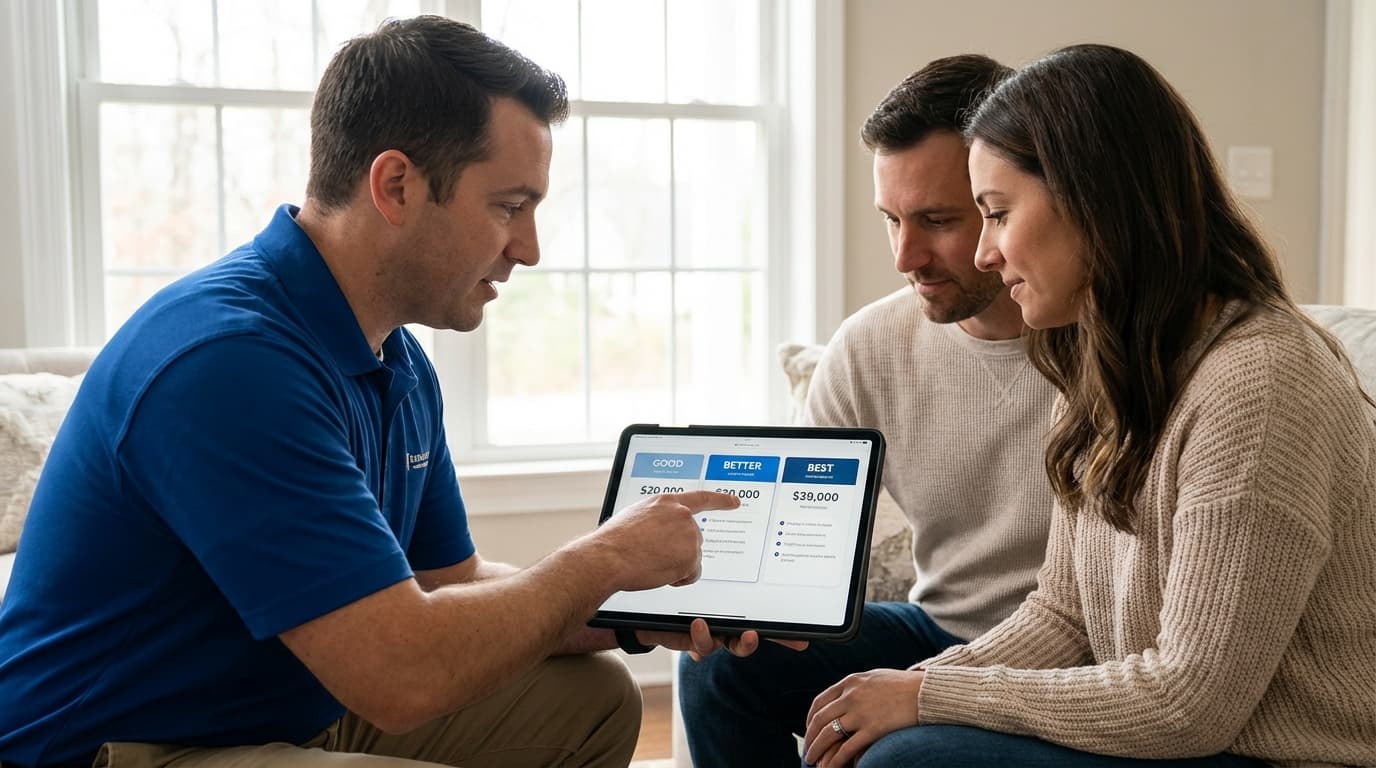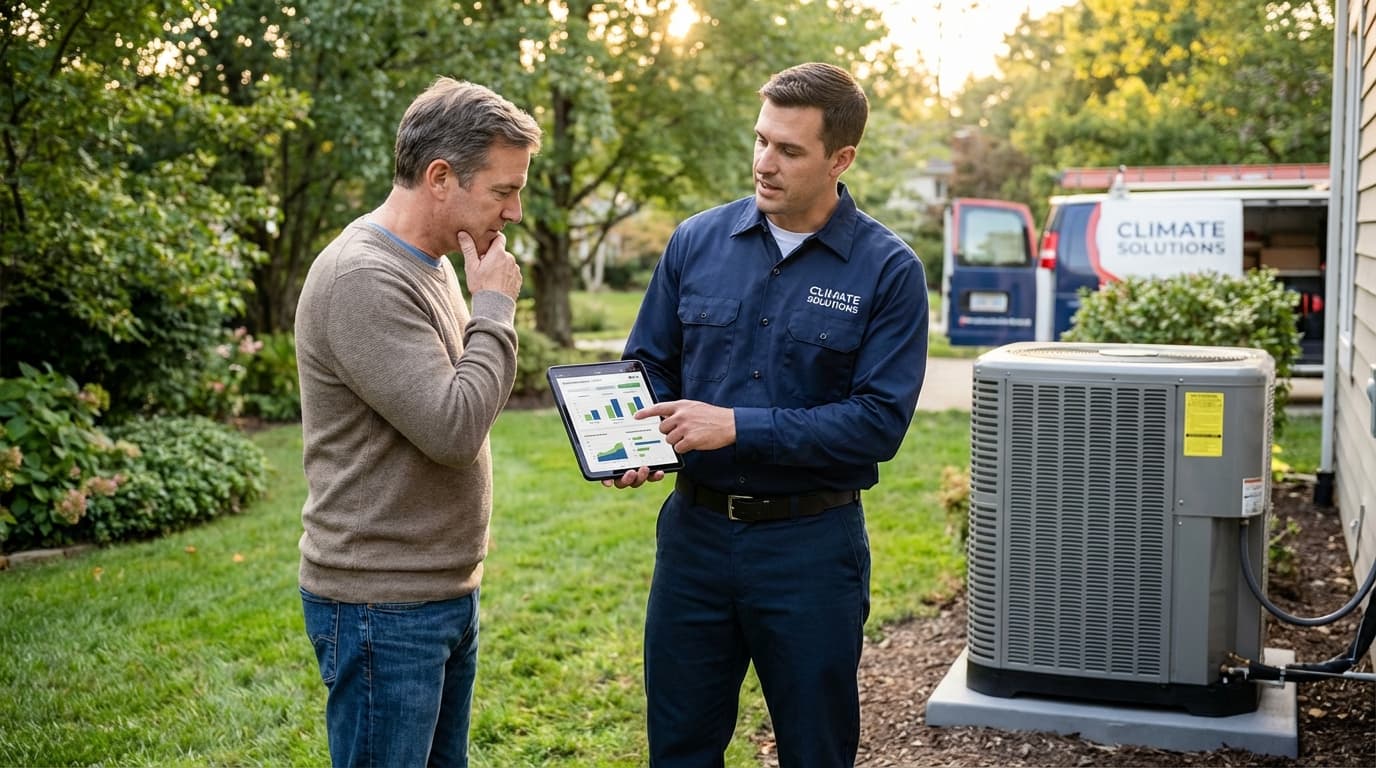
"Your price is way too high." The homeowner crosses his arms. You just spent 45 minutes doing a thorough inspection, explaining the failing compressor, presenting three system options with efficiency ratings and warranty comparisons. His neighbor got a quote for $3,000 less.
You know that quote is for a builder-grade unit with a 5-year warranty installed by a crew that won't be in business in three years. But you don't know how to say that without sounding defensive. So you mumble something about quality, offer a small discount, and drive away without the deal.
TL;DR: HVAC sales objections are predictable—price, timing, spouse consultation, and competitor comparisons account for 87% of all resistance. Technicians trained in objection handling close 34% more replacement sales and achieve 23% higher average tickets by reframing objections as opportunities to add value rather than reduce price.
Objections aren't rejection. They're requests for more information, better framing, or reassurance. The homeowner who says "that's too expensive" is really saying "help me understand why this is worth it." Here's how to handle every HVAC objection you'll face.
Understanding HVAC Sales Objections
Objections feel personal, but they're predictable patterns. Understanding why homeowners object helps you respond effectively.
The psychology behind objections:
| Objection Type | What They're Really Saying | What They Need |
|---|---|---|
| Price | "I'm not sure the value justifies the cost" | Better value framing |
| Timing | "I'm not ready to decide today" | Urgency or permission to wait |
| Spouse | "I can't decide alone" | Tools to sell internally |
| Competitor | "Someone offered something different" | Comparison clarity |
| Trust | "I don't know if I can trust you" | Credibility signals |
Why objections are actually good:
- Engaged customers object. Silent customers just don't call back.
- Objections reveal what matters to them.
- Handled well, objections build trust.
- Each objection addressed removes a barrier to yes.
The worst outcome isn't an objection—it's "let me think about it" with no real concerns expressed. Those deals die silently.
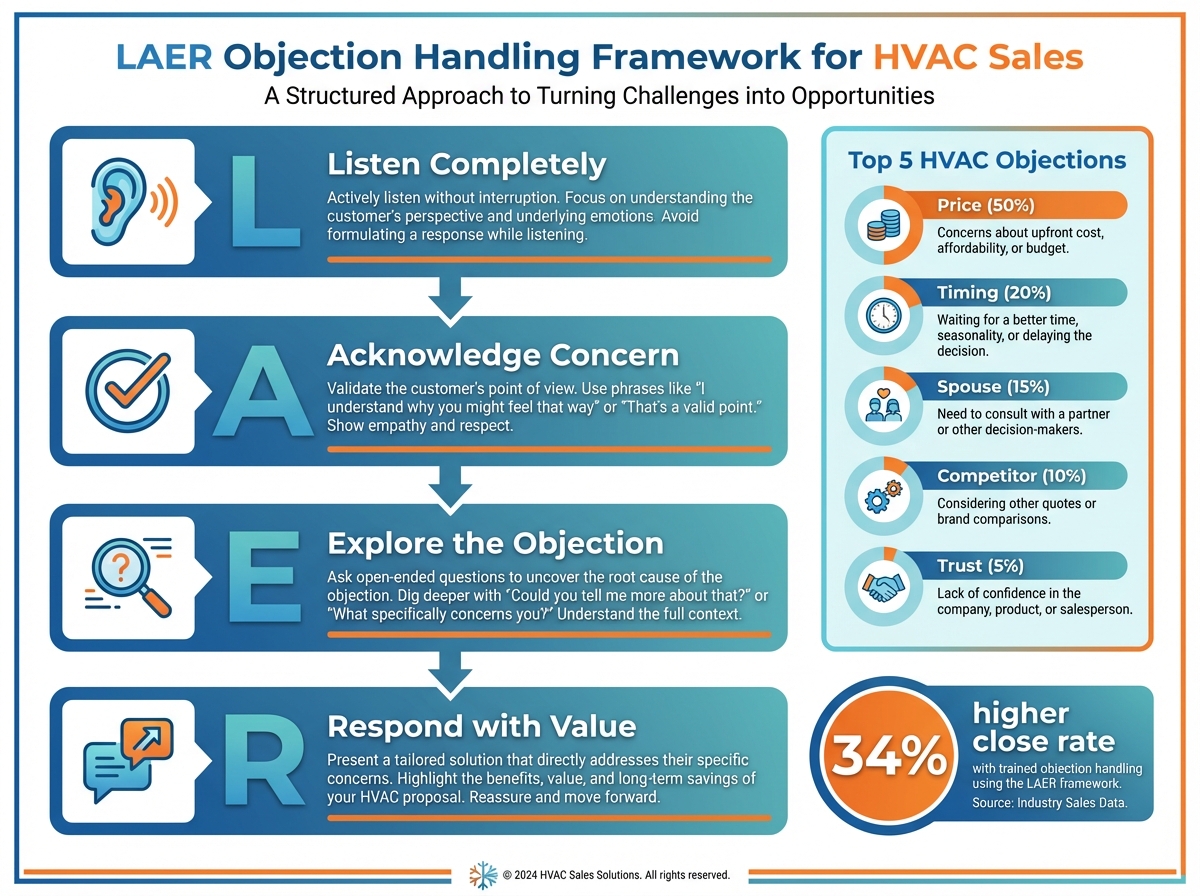
The LAER Objection Handling Framework
Before diving into specific objections, master this universal framework.
L - Listen Completely
Let them finish. Don't interrupt. Don't start formulating your response while they're talking. Hear the complete objection.
A - Acknowledge the Concern
Validate their perspective before responding. "I completely understand" or "That's a fair concern" diffuses defensiveness.
E - Explore the Objection
Ask clarifying questions. "Help me understand—is it the total price or the monthly payment that concerns you?" Get specific before responding.
R - Respond with Value
Address the real concern with information that reframes the situation. Don't defend—add perspective.
Example in action:
Customer: "Your price is too high."
Listen: [Let them finish, even if they add more]
Acknowledge: "I hear you—$12,000 is a significant investment."
Explore: "Help me understand what you're comparing to. Is it another quote, what you expected, or what fits your budget?"
Respond: [Based on their answer—see specific scripts below]
Price Objections: The Most Common Challenge
Price objections account for over 50% of HVAC sales resistance. Master these scripts.
"Your Price Is Too High"
Explore first:
"I appreciate you being direct. Too high compared to what—another quote you received, what you were expecting, or what you'd like to spend?"
If comparing to another quote:
"Tell me about that quote. What brand system? What efficiency rating? What warranty terms? Who's the contractor?
[After they share] Here's what I've noticed with quotes that come in significantly lower: [specific differences—brand tier, warranty, installation quality, company longevity]. I want to make sure you're comparing equivalent options.
Our price includes [differentiators: 10-year parts AND labor warranty, name-brand equipment, licensed installation crew, 24/7 service commitment]. When you factor that in, you might find the real cost over 10-15 years looks different."
If comparing to expectation:
"What were you expecting? I'm curious where that number came from.
[Listen] That may have been accurate [X years ago / for a smaller system / for a repair vs. replacement]. The reality is [explain market context—equipment costs, labor, regulatory requirements].
I can't sell you a quality system for less than it costs to install one properly. What I can do is show you financing options that make the monthly payment manageable."
If about budget:
"I completely understand budget constraints. Let me ask—is the concern the total price or the monthly payment?
If it's monthly cash flow, we have financing at [rate] that would put this at about $[monthly] per month. That's less than most people spend on [relatable comparison—streaming services, coffee, etc.].
If the total is the concern, let me show you Option B again—it gives you [core benefits] at a lower price point. You're giving up [what's different], but it solves the immediate problem."
"That's More Than I Wanted to Spend"
"Totally fair. Nobody wakes up hoping to spend $12,000 on HVAC equipment.
Here's how I look at it: your current system is costing you $[estimated monthly] extra in energy bills based on its efficiency rating. The new system pays back about $[savings] monthly in lower utility costs. Over 15 years, you're actually [ahead/behind] on total cost of ownership.
Plus, you're not dealing with breakdown risks, emergency repair bills, or the discomfort of a failing system.
Does looking at it as a long-term investment rather than a one-time expense change how you see it?"
"I Can't Afford It Right Now"
"I understand. Big expenses are never convenient. Let me ask—can you afford for your system to fail completely in July?
[If they acknowledge risk] The challenge with waiting is you lose control of timing. Emergency replacements happen on the hottest day, when every contractor is booked, and you pay premium prices for rush installation.
With financing, you could start at $[monthly payment] today and have a new, reliable system before the weather turns. That payment might actually be less than what you'd spend on emergency repairs or a hotel room when it fails.
Would it make sense to at least see what financing you'd qualify for?"
Timing Objections: "I Need to Think About It"
This objection kills more deals than any other—because it feels polite but means almost nothing.
"I Need to Think About It"
Explore the real concern:
"Of course—this is a big decision. Help me out: what specifically do you want to think about? Is it the timing, the investment, the equipment choice, or something about our company?"
Then address whatever they reveal:
| Real Concern | Response Approach |
|---|---|
| Price | Revisit value, offer financing |
| Timing | Create urgency, offer scheduling flexibility |
| Equipment | Provide more education, simplify options |
| Company trust | Share reviews, references, credentials |
| Spouse | Offer to include them, provide materials |
If they won't specify:
"I want to make sure you have everything you need to decide. If you think about it tonight and realize you have a question, you'll have to call me back, wait for answers, and delay the process.
Let's take 5 more minutes now to address anything that's unclear. What would help you feel confident about this decision?"
"I Want to Wait Until [Season/Event]"
"What's making you want to wait until [time they mentioned]?
[Listen for real reason]
Here's what I've seen: contractors get slammed in [peak season]. Wait times go from days to weeks. Prices often increase because demand is high and we're working overtime.
Right now, I can get you on the schedule for [date], lock in today's pricing, and you'll be ready before [their concern—summer heat, winter cold, the event].
The system doesn't get more expensive to install later—but your wait time and my availability will change. Does it make sense to lock in now while you can control the timing?"
"I'm Not Ready to Decide Today"
"I respect that. Quick decisions on big purchases can feel uncomfortable.
Can I ask what would make you ready? More information? Time to review the proposal? A conversation with someone else?
[Based on their answer, either address it now or set a specific follow-up]
Here's what I'll commit to: I'll follow up [specific day/time] to answer any questions that come up. My proposal is good until [date]. Fair?"
Spouse/Partner Objections
Never make the customer feel bad for consulting their partner. Facilitate the conversation instead.
"I Need to Talk to My Spouse"
Option 1: Include them now
"Absolutely—this is a decision you should make together. Is [spouse name] available now? I'd be happy to walk them through what we discussed so you can decide together. Even a quick phone call could help."
Option 2: Equip them to present
"Of course. What questions do you think they'll have?
[Address each one]
Let me put together a summary with photos of what I found, the options, and pricing. You'll have everything you need to walk them through it.
What's the best time for me to follow up after you've talked?"
Option 3: Offer a second visit
"I understand completely. Would it help if I came back when you're both available? I want to make sure both of you feel good about the decision.
What time works for both of you? [Schedule specific appointment]"
"My Spouse Handles These Decisions"
"Got it—I should be talking to them. Can we get them on the phone now, or should I schedule a time to present this when they're available?
I want to make sure the decision-maker has all the information. It's not fair to you to have to relay everything I explained."
Competitor Objections
Competitor comparisons require tact. Never trash-talk—differentiate.
"I'm Getting Other Quotes"
"Smart—you should. When you're comparing, here's what I'd suggest looking at:
First, equipment: What brand and model? What efficiency rating? Same capacity?
Second, warranty: Parts only or parts AND labor? How long? What's excluded?
Third, the contractor: How long in business? Licensed and insured? Reviews? Will they be here in 5 years if you need warranty service?
Fourth, what's included: Permit? Inspection? Disposal of old equipment? Modifications to ductwork or electrical?
Some quotes look cheaper until you realize what's missing. When you get other quotes, call me back—I'm happy to help you understand the differences.
When are you planning to decide? I'll follow up then."
"Your Competitor Is $3,000 Less"
"That's a significant difference. Let's figure out why.
Do you have that quote with you? Let's compare line by line.
[If they have it, review together]
[Common differences to look for:]
- Equipment brand and tier (builder-grade vs. premium)
- Efficiency rating (13 SEER vs. 16+ SEER)
- Warranty terms (parts only vs. parts and labor)
- What's included (permit, inspection, disposal, modifications)
- Company reputation and longevity
A $3,000 difference usually means something is different. It might be the right choice for you—but you should know what you're giving up.
Based on what you told me matters to you—[their stated priorities]—which option actually delivers that?"
"I Already Have a Quote I Like"
"Great—sounds like you've done your homework. What did you like about that quote?
[Listen]
Those are good points. Here's what makes our approach different: [key differentiators].
If [their liked quote] still feels like the best fit after comparing, I respect that. But you should have all the information before deciding.
What would it take for you to consider us instead?"
Trust and Credibility Objections
Some objections are really about whether they trust you and your company.
"I've Never Heard of Your Company"
"Fair point—we may not have the biggest advertising budget. Here's what we do have:
[Share relevant credibility markers]
- X years in business
- X installations completed
- [Rating] on Google/Yelp with [number] reviews
- Licensed, bonded, and insured
- [Certifications or manufacturer partnerships]
I can also give you references from customers in your neighborhood if you'd like to call them directly.
What would help you feel confident about working with us?"
"How Do I Know This Is Really Necessary?"
"That's a fair question—you shouldn't just take my word for it. Let me show you exactly what I found.
[Show photos and explain each issue]
This isn't something I'm making up—you can see [specific evidence]. If you want a second opinion, I'd encourage you to get one.
What I can tell you is: based on [specific findings], [consequence of waiting]. You could wait and see what happens, but here's the risk: [specific risk].
Does what I'm showing you make sense?"
"I Had a Bad Experience with a Contractor Before"
"I'm sorry to hear that. What happened?
[Listen fully—this builds trust]
I understand why you'd be cautious. Here's how we're different: [address their specific concern].
We also [guarantee/policy that protects them]. If anything goes wrong, here's how we handle it: [specific process].
I can't undo what happened before, but I can show you a different experience. What would help you feel comfortable moving forward?"
Advanced Objection Techniques
Once you master the basics, add these advanced approaches.
The Feel-Felt-Found Method
"I understand how you feel. Many homeowners have felt the same way. What they found was [positive outcome]."
Example:
"I understand how you feel about the price—it's a significant investment. Many homeowners felt the same way initially. What they found was that the energy savings, reliability, and warranty protection actually made it the more economical choice over time."
The Isolation Technique
"If we could solve [their objection], would you be ready to move forward?"
This confirms whether the stated objection is the real (or only) issue.
Example:
"If financing made the monthly payment fit your budget, would you be ready to get this scheduled?"
If yes, you know what to focus on. If no, there's another objection to uncover.
The Takeaway
Sometimes removing pressure creates commitment.
"You know what—this might not be the right time for you. Let me leave my card. When your system fails completely and you need emergency service, call me. I'll try to fit you in.
[Pause—let them respond]"
Often, homeowners will pull back from the edge when they feel the pressure removed.
Building an Objection Handling Culture
Individual skills matter, but systems ensure consistency.
Training requirements:
| Frequency | Activity |
|---|---|
| Weekly | Role-play one objection type as a team |
| Monthly | Review recorded calls with objection examples |
| Quarterly | Update scripts based on new objections encountered |
| Annually | Full objection handling refresher training |
Tracking and improvement:
- Log objections encountered by type
- Track conversion rate by objection type
- Identify which reps handle which objections best
- Share successful scripts across the team
CRM integration:
Record objections in your CRM for:
- Pattern recognition across customers
- Technician-specific coaching needs
- Script refinement based on what works
Frequently Asked Questions
What if I try everything and they still won't buy?
Some deals aren't meant to close. Maybe timing really is wrong, budget truly doesn't fit, or they've decided on a competitor. Your job is to give them every opportunity to say yes. If they still say no, leave the door open: "I understand. If anything changes or you have questions later, please call me directly. My offer stands if you change your mind."
How do I handle price objections without discounting?
Discounting trains customers to object. Instead: reframe value (total cost of ownership, not purchase price), offer financing (monthly payment, not total), or present a lower-tier option (different product, not discounted price). Only discount if there's a legitimate competitive or strategic reason—and document it.
What's the biggest objection handling mistake technicians make?
Answering too quickly. When you respond instantly, you signal that you're not listening and that your answer is rehearsed. Pause. Acknowledge. Explore. Then respond. The two-second pause before responding dramatically increases trust and conversion.
Master Objection Handling for HVAC Sales
Every objection is an opportunity disguised as resistance. Homeowners who object are engaged—they're processing information and working toward a decision.
Key takeaways for HVAC sales professionals:
- Use the LAER framework: Listen, Acknowledge, Explore, Respond
- Price objections need reframing, not discounting
- "I need to think about it" requires identifying the real concern
- Spouse consultations are opportunities to equip or include
- Competitor comparisons require differentiation, not disparagement
- Trust objections need credibility evidence
Practice these scripts until they're natural. Record yourself. Role-play with colleagues. Track your conversion rates by objection type.
The difference between average and great HVAC salespeople isn't avoiding objections—it's welcoming them as the path to yes.
Want to track your objection handling success rates? Start your free trial with TruLine and see which scripts close the most deals.