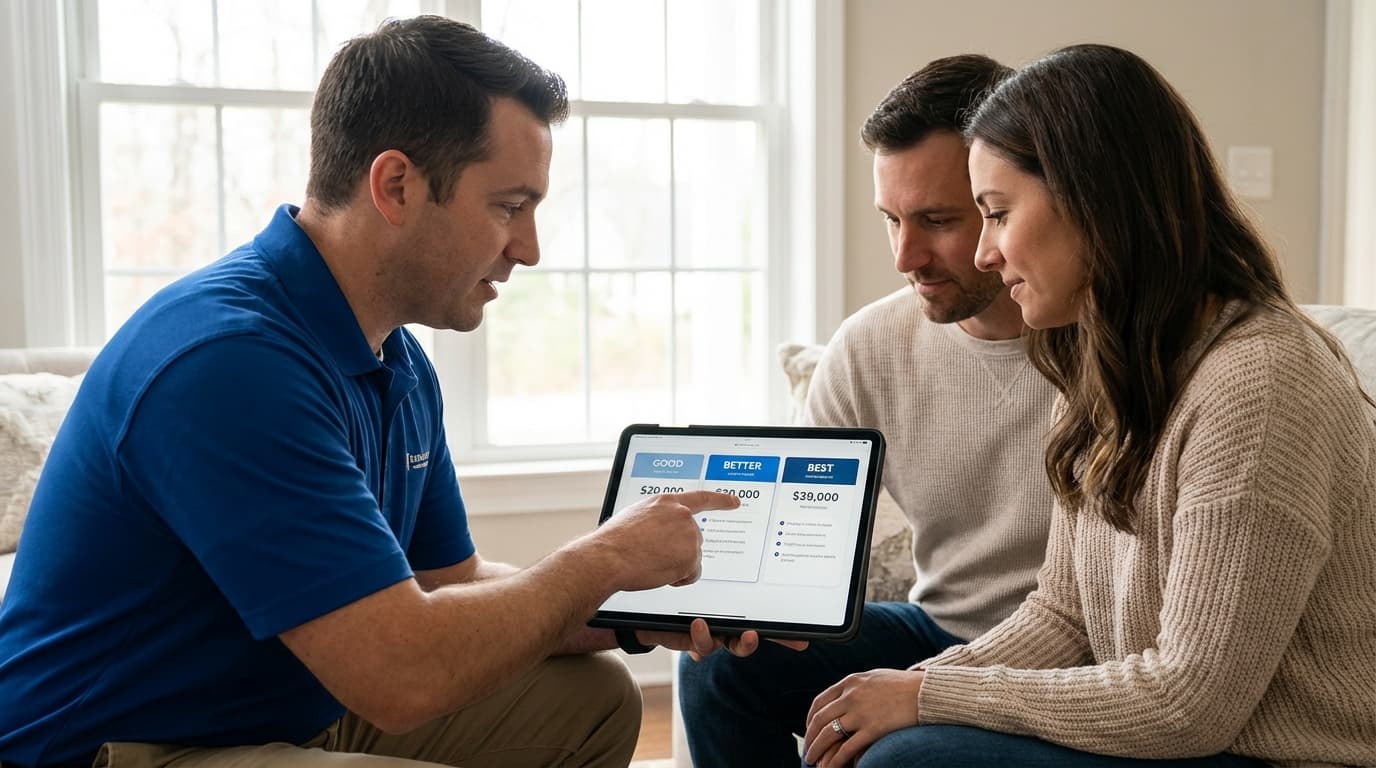
Two contractors quote the same water heater installation. One says "$2,400." The other presents three options at $1,895, $2,695, and $3,495—and recommends the middle one.
The second contractor closes at a higher rate AND a higher average ticket. Same work. Same equipment. Different psychology.
Pricing isn't just math. It's psychology. How you present your prices matters as much as what you charge. The contractors who understand this close more deals at better margins—without being sleazy or manipulative.
TL;DR: Pricing psychology applies behavioral science to how you present prices. Key techniques include anchoring (showing a high price first), charm pricing ($2,495 vs. $2,500), option framing (good-better-best), and value demonstration (showing what's included). These techniques typically increase close rates 15-25% and average ticket 10-20%. The goal isn't manipulation—it's helping customers make confident decisions.
Smart pricing presentation helps customers understand value and feel good about their purchase.
The Psychology Behind Pricing Decisions
Understand why customers react to prices the way they do.
How Customers Evaluate Prices
Customers don't evaluate price objectively—they evaluate it relative to:
- What they expected to pay
- Other options presented
- The perceived value received
- What alternatives cost
- Their emotional state
Key insight: A $5,000 HVAC system feels expensive when presented alone. The same system feels reasonable when presented after a $8,000 option.
Common Psychological Principles
| Principle | What It Means | Application |
|---|---|---|
| Anchoring | First number influences all subsequent judgments | Present premium option first |
| Loss aversion | Losses feel 2x worse than equivalent gains | Frame savings, not costs |
| Choice architecture | How options are presented affects decisions | Design option structure carefully |
| Social proof | People follow what others do | "Most popular" labels |
| Scarcity | Limited availability increases value | Time-limited offers |
The Emotional Decision Process
Home service purchases are emotional:
- Something broke or needs improvement (stress)
- Unknown cost creates anxiety
- Multiple options create overwhelm
- Clear recommendation creates relief
- Confidence in choice creates satisfaction
Your pricing presentation should guide this emotional journey.
Technique 1: Anchoring
The first price customers hear shapes all subsequent price perception.
How Anchoring Works
Without anchor:
- "The repair is $450"
- Customer thinks: "Is that expensive? Cheap? I don't know."
With anchor:
- "A new system would run $6,000-8,000. But we can repair this for $450."
- Customer thinks: "Compared to replacement, that's very reasonable!"
Same price, completely different perception.
Anchoring Strategies for Contractors
Strategy 1: Present premium option first
- Start with highest-priced option
- Move down to standard and basic
- Middle option feels like a deal
Strategy 2: Reference replacement cost
- "Replacement would be $X..."
- "Compared to replacement..."
- Makes repair feel reasonable
Strategy 3: Show industry/regional averages
- "The average cost for this service is $X..."
- Position your price favorably
Strategy 4: Quote range before specific
- "These typically run $800-1,200. Yours is $950."
- Creates context for number
Anchoring Script Example
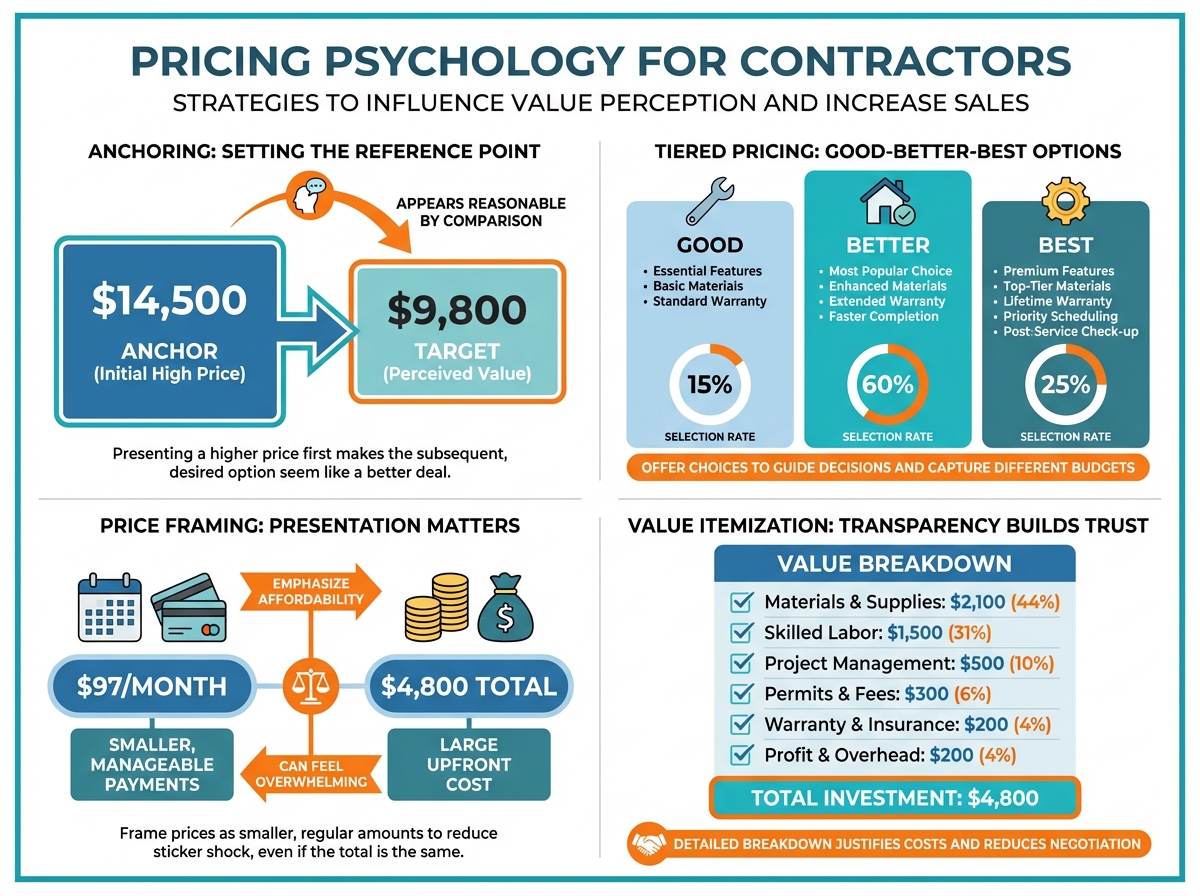
"For this issue, you have three options. Our premium solution is a complete system replacement at $14,500—this gives you the newest technology and 10-year warranty.
Our standard solution is the mid-efficiency unit at $9,800, which most homeowners choose.
The basic option is repairing your current system at $1,200, though given its age, we might be back in 6-12 months.
Based on what you told me about staying in the home long-term, I'd recommend the standard option."
The $14,500 anchor makes $9,800 feel reasonable.
Technique 2: Good-Better-Best Options
Three options is the magic number for home services.
Why Three Options Work
One option: Customer decides yes or no Two options: Customer decides which one (but feels limited) Three options: Customer feels empowered to choose (usually picks middle) Four+ options: Customer gets overwhelmed, delays decision
The Good-Better-Best Framework
| Option | Position | Purpose | Selection Rate |
|---|---|---|---|
| Best (Premium) | Highest price | Sets anchor, captures high-value buyers | 15-25% |
| Better (Standard) | Middle price | Target option for most customers | 50-65% |
| Good (Basic) | Lowest price | Captures budget-conscious, shows range | 15-25% |
Designing Your Options
Each option should be clearly different:
| Element | Basic | Standard | Premium |
|---|---|---|---|
| Equipment tier | Entry-level | Mid-grade | Top-of-line |
| Warranty | 1 year | 5 years | 10 years |
| Efficiency | Standard | High | Highest |
| Included services | Core only | Core + maintenance | Core + maintenance + priority |
| Price gap | Base | +30-40% | +70-100% |
Important: Don't make basic too attractive or premium too expensive.
Option Presentation Script
"I've put together three options based on what we discussed:
Option A is our premium package at $12,400. You get the high-efficiency unit, 10-year parts and labor warranty, and annual maintenance included for 3 years. This is what I'd put in my own home.
Option B is our most popular at $9,200. Same quality installation, 5-year warranty, and one year of maintenance included. About 60% of our customers choose this.
Option C is $6,800 for the basic system with standard warranty. It'll cool your home, but you're giving up efficiency and warranty protection.
Given what you said about energy bills being a concern, I'd recommend Option B. It balances efficiency and value. What questions do you have?"
Technique 3: Price Framing
How you present the number matters as much as the number itself.
Monthly vs. Total Framing
Which sounds more affordable?
- "$4,800 for the water heater"
- "$97/month for 60 months with 0% financing"
Same cost, different psychological impact.
When to use monthly framing:
- Large purchases ($3,000+)
- When financing is available
- When monthly payment fits budget
- When total seems intimidating
When to use total framing:
- Small to medium purchases
- When customer paying cash
- When total seems reasonable
- When monthly payment is high
Per-Day and Per-Use Framing
Maintenance agreement framing:
- Annual: "$199/year for maintenance"
- Monthly: "Just $16.58/month"
- Daily: "About 55 cents a day for peace of mind"
Daily framing works for:
- Subscriptions and agreements
- Comparing to common purchases (coffee, lunch)
- Making recurring costs feel small
Savings vs. Cost Framing
Loss aversion: People feel losses more strongly than gains.
Cost frame: "The high-efficiency unit costs $2,000 more." Savings frame: "The high-efficiency unit saves you $400/year on energy—it pays for itself in 5 years and then puts money in your pocket."
Always frame as savings or gains when possible.
Charm Pricing (The "9" Effect)
$2,495 vs. $2,500
Research shows prices ending in 9 or 5 feel lower:
- $1,995 feels closer to $1,000 than $2,000
- Works for services under $5,000 especially
- Less effective for premium positioning
When to use:
- Competing on price
- Budget-conscious customers
- Promotional pricing
When to avoid:
- Premium positioning
- Very large purchases
- When precision matters
Technique 4: Value Demonstration
Show what's included—don't let price stand alone.
Itemized Value Display
Weak presentation:
"AC installation: $8,500"
Strong presentation:
Your Complete AC Installation Package - $8,500
- Carrier 16 SEER AC unit ($4,200 value)
- Professional installation by NATE-certified tech ($2,500 value)
- New thermostat with programming ($350 value)
- 10-year parts warranty ($600 value)
- 2-year labor warranty ($400 value)
- First-year maintenance included ($199 value)
- Permit and inspection fees ($250 value)
Total Value: $8,499 Your Price: $8,500
Suddenly $8,500 looks like a deal.
Comparison Tables
Show what's included at each level:
| Feature | Basic $6,800 | Standard $9,200 | Premium $12,400 |
|---|---|---|---|
| Unit efficiency | 14 SEER | 16 SEER | 18 SEER |
| Warranty - parts | 5 years | 10 years | 10 years |
| Warranty - labor | 1 year | 2 years | 5 years |
| Smart thermostat | ❌ | ✓ | ✓ |
| Maintenance included | ❌ | 1 year | 3 years |
| Priority service | ❌ | ❌ | ✓ |
Customers see exactly what more money buys.
Highlighting What's NOT Included (Ethically)
For lower-priced options:
"The basic option doesn't include the extended warranty—if something goes wrong after year one, repairs would be out of pocket."
This helps customers make informed decisions, not manipulate them.
Technique 5: Social Proof in Pricing
People follow what others do.
"Most Popular" Labels
On your options:
- "Our most popular choice"
- "What 60% of homeowners select"
- "Best seller"
These labels significantly increase selection of that option.
Testimonials Tied to Options
"Mrs. Johnson in your neighborhood chose the standard package last year. She mentioned her energy bills dropped $50/month."
Local social proof is most powerful.
Review Counts
When presenting:
"This unit has a 4.8-star rating from over 500 homeowner reviews."
Third-party validation removes risk perception.
Technique 6: Urgency and Scarcity
Create legitimate reasons to decide now.
Legitimate Urgency Tactics
| Tactic | Example | When Appropriate |
|---|---|---|
| Seasonal pricing | "Summer rates start next week" | Actual seasonal pricing |
| Capacity | "We have 3 installation slots this week" | True capacity constraints |
| Rebates ending | "Utility rebate expires March 31" | Real rebate deadlines |
| Material costs | "Prices are increasing—this quote valid 30 days" | True market conditions |
Avoid Fake Urgency
What NOT to do:
- Artificial countdown timers
- "Today only" that resets daily
- Fake scarcity that doesn't exist
- Pressure tactics that create regret
These damage trust and generate negative reviews.
Price Protection Offers
"I can hold this price for 14 days. After that, I'd need to re-quote based on current material costs."
Creates urgency without pressure—gives customer control.
Ethical Considerations
Pricing psychology should help customers, not exploit them.
The Ethics Test
Ask yourself:
- Would I present this way to my mother?
- Does this help the customer make a better decision?
- Would I be comfortable if this were recorded?
- Am I presenting truthfully?
What's Ethical
✅ Presenting options clearly ✅ Anchoring to set context ✅ Highlighting value included ✅ Using social proof truthfully ✅ Creating legitimate urgency
What's Not Ethical
❌ Hidden fees added later ❌ Fake urgency or scarcity ❌ Misleading comparisons ❌ Pressure to decide immediately ❌ Taking advantage of vulnerable customers
Building Long-Term Value
Short-term manipulation costs:
- Negative reviews
- No referrals
- Cancellations and chargebacks
- Reputation damage
Ethical pricing psychology builds:
- Customer confidence
- Positive reviews
- Referral willingness
- Repeat business
Implementation Checklist
Put these techniques into practice.
Immediate Actions
- Create three-option pricing for all major services
- Update proposals to show itemized value
- Add "most popular" labels to standard options
- Train team on anchor-first presentation
- Develop financing talking points
Proposal Template Updates
- Lead with premium option
- Include comparison table
- Add value summaries for each option
- Include relevant testimonials
- Note price validity period
Training Focus
- Option presentation sequence
- Anchoring scripts
- Value framing language
- Handling price objections
- Ethical boundaries
Frequently Asked Questions
Isn't pricing psychology manipulative?
It can be, but it doesn't have to be. Ethical pricing psychology helps customers understand value and make confident decisions. The techniques help overcome decision paralysis and comparison confusion—common problems for homeowners facing unfamiliar purchases. The key is presenting truthfully and giving customers genuine choices.
Should I use charm pricing ($2,495) or round numbers ($2,500)?
For most home services, charm pricing ($X,995 or $X,95) works well for standard and basic options. For premium options where you want to convey quality, round numbers can feel more substantial. Test both and track conversion rates.
How do I handle customers who only want the cheapest option?
Present all options, but don't judge customers who choose basic. Some have budget constraints; others will upgrade later. A basic customer today might be a premium customer next year. Always deliver excellent service regardless of option chosen—that's what generates referrals and upgrades.
Price Smarter, Not Lower
Pricing psychology isn't about charging more for the same thing. It's about presenting your genuine value in ways customers can understand and appreciate. The same service, presented differently, can close more deals at better margins—while leaving customers more satisfied.
Key takeaways:
- Anchor with premium option first to create context
- Always present three options (good-better-best)
- Frame prices in terms of value and savings
- Use social proof ("most popular") to guide decisions
- Create legitimate urgency without pressure
- Stay ethical—long-term reputation beats short-term gains
The contractors who master pricing psychology don't compete on being cheapest. They compete on being clearest about value—and they win.
Ready to track which pricing strategies convert best? Start your free trial with TruLine and see close rates by option and presentation method.