Your top salesperson closes 45% of their estimates. Your average tech closes 18%. That's not a talent gap—it's a training gap. The top performer isn't smarter; they've internalized a system that others haven't been taught.
Most HVAC companies hire technicians for technical skills and hope sales ability develops naturally. It doesn't. Sales is a skill that must be trained, practiced, and reinforced. Companies that treat it otherwise leave millions on the table.
TL;DR: A structured HVAC sales training program lifts team-wide close rates by 15-25% within 90 days. Effective programs combine classroom learning, field ride-alongs, role-play practice, and ongoing coaching. The investment pays back quickly—a 5% close rate improvement on 100 monthly estimates at $12,000 average ticket generates $720,000 additional annual revenue.
Individual sales talent matters less than systematic training. Here's how to build a program that lifts your entire team.
Why Team-Wide Training Beats Individual Talent
Relying on star salespeople creates business risk. Systematic training creates sustainable advantage.
The star performer problem:
| Risk | Consequence |
|---|---|
| Star leaves | Revenue drops overnight |
| Star gets sick | Month's pipeline stalls |
| Star can't scale | Growth limited by one person |
| Team resents star | Culture problems develop |
| Star burns out | Unsustainable workload |
The systematic training advantage:
| Benefit | Business Impact |
|---|---|
| Consistent performance | Predictable revenue |
| Reduced dependence | Business survives changes |
| Faster onboarding | New hires productive quickly |
| Knowledge transfer | Best practices spread |
| Scalable growth | Add people, add revenue |
Companies with formal sales training programs outperform those without by 57% on revenue growth. The investment isn't optional for serious growth.
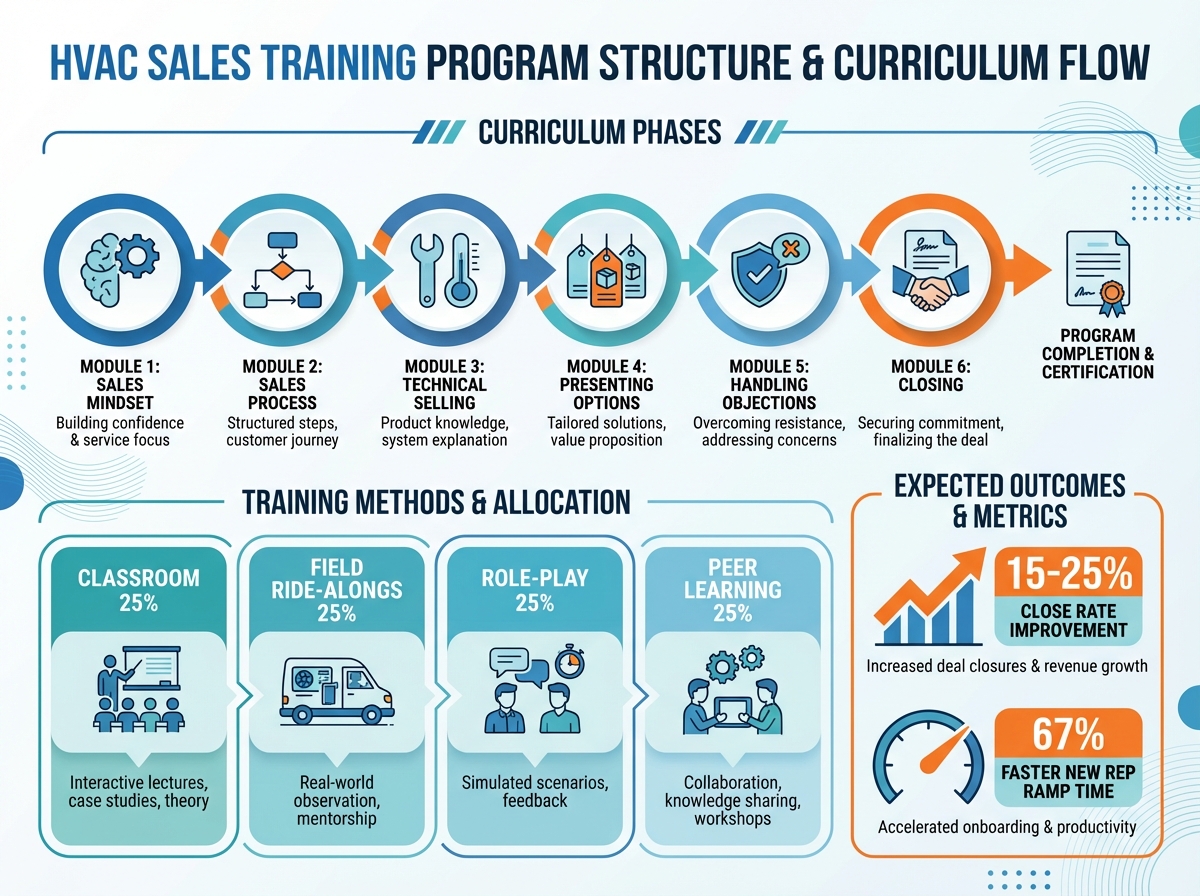
Building Your HVAC Sales Training Curriculum
Effective training covers both mindset and mechanics.
Module 1: Sales Mindset Foundation
Why it matters: Technicians often resist "selling." They entered the trade to fix things, not pitch products. Address the mindset barrier first.
Key concepts to teach:
Reframing sales as service:
- "Selling" is helping customers make good decisions
- Not selling leaves customers with problems
- Customers want guidance, not just information
- You're the expert—act like it
The cost of not selling:
| Scenario | Customer Impact |
|---|---|
| Tech doesn't mention failing capacitor | Customer faces emergency breakdown |
| Tech doesn't offer maintenance plan | Customer overpays for reactive service |
| Tech doesn't discuss replacement options | Customer keeps wasting money on repairs |
Training activity: Have each team member share a time when they were grateful a salesperson helped them make a purchase decision. Connect to their own customer interactions.
Module 2: The HVAC Sales Process
Break down the complete customer interaction.
Step 1: Pre-Call Preparation
- Review customer history in CRM
- Check equipment records
- Know the neighborhood/area
- Prepare relevant materials
Step 2: Arrival and Rapport
- Punctuality and professional appearance
- Introduce yourself by name
- Warm-up conversation (not interrogation)
- Set expectations for the visit
Step 3: Diagnosis and Discovery
- Technical inspection
- Ask about comfort concerns
- Understand their situation and priorities
- Document findings with photos
Step 4: Education and Options
- Explain findings clearly
- Show (don't just tell) the issues
- Present options with clear differences
- Recommend based on their stated priorities
Step 5: Handle Concerns
- Listen fully before responding
- Acknowledge their perspective
- Address with value, not defense
- Check for understanding
Step 6: Close
- Ask for the decision
- Make the next step easy
- Handle logistics smoothly
- Confirm everything in writing
Training activity: Role-play each step separately, then string them together. Video record for review.
Module 3: Technical Selling Skills
Connect technical knowledge to customer value.
Translating features to benefits:
| Technical Feature | Customer Benefit |
|---|---|
| Variable-speed motor | "Quieter, more even comfort, lower bills" |
| Two-stage compressor | "Better humidity control, longer equipment life" |
| High SEER rating | "Lower monthly bills, smaller environmental impact" |
| Smart thermostat integration | "Control from anywhere, learn your schedule automatically" |
Training activity: Create a "translation guide" for every product feature. Practice until customer language becomes automatic.
Explaining without overwhelming:
- Use analogies customers understand
- Limit technical jargon
- Check understanding frequently
- Focus on what matters to them
Module 4: Presenting Options Effectively
Multi-option presentations outperform single quotes.
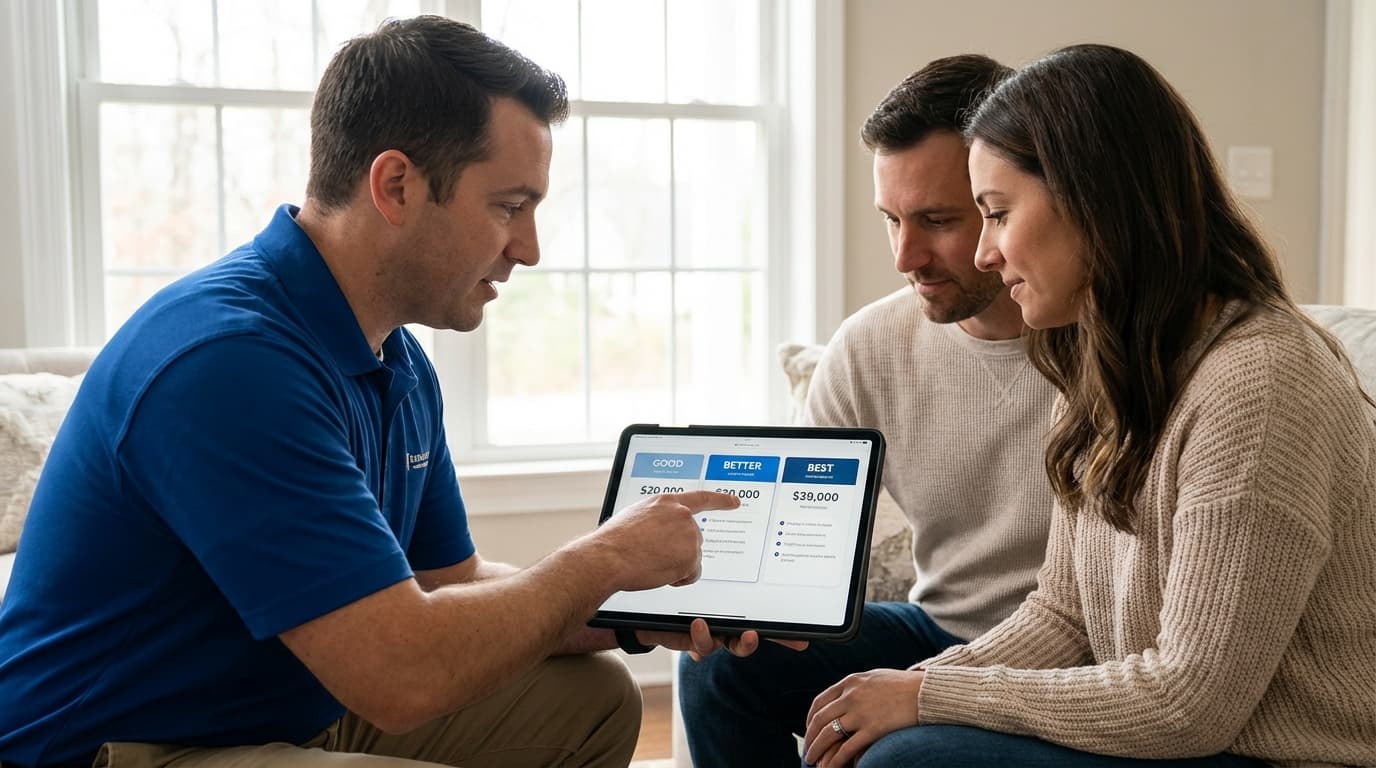
The three-option framework:
| Option | Position | Typical Result |
|---|---|---|
| Premium (Good) | "If you want the best" | 15-25% select |
| Standard (Better) | "Most popular choice" | 50-60% select |
| Basic (Best Value) | "Gets the job done" | 20-30% select |
Presentation sequence:
- Start with customer's stated needs
- Present premium option first (anchors value)
- Present standard as the sweet spot
- Present basic for budget-conscious
- State your recommendation and why
Script example:
"Based on what you've told me—energy efficiency matters and you plan to stay in this home long-term—I've put together three options:
Option A is our top-of-the-line system at $14,500. You get [specific features]. This is what I'd put in my own home.
Option B is our most popular at $11,200. Same quality installation, just [difference]. Most customers choose this.
Option C is $8,400 and solves the immediate problem. You're giving up [differences]. Good if budget is the priority.
Given your priorities, I recommend Option B. Here's why..."
Training activity: Practice presenting the same three options until it flows naturally. Time the presentation—should be 3-5 minutes, not 15.
Module 5: Handling Objections
Every objection has a trained response.
The LAER method:
- Listen completely
- Acknowledge the concern
- Explore the specifics
- Respond with value
Common HVAC objections and responses:
Review detailed scripts in our HVAC objection handling guide.
Training activity: Objection drill. One person raises objections, another responds using LAER. Switch roles. Increase difficulty with rapid-fire objections.
Module 6: Closing Techniques
Asking for the decision is non-negotiable.
Closing approaches:
| Close Type | When to Use | Example |
|---|---|---|
| Direct | Confident moment | "Should we get you on the schedule?" |
| Alternative | Narrowing options | "Would you prefer Option A or B?" |
| Assumptive | High buying signals | "Let's get you set up for Thursday. Morning or afternoon?" |
| Summary | After addressing concerns | "So we've addressed your concerns about [X]. Ready to move forward?" |
Training rule: Every presentation ends with asking for the decision. No exceptions. Even "not today" is better than no ask.
Training activity: Practice each close type. Identify which feels most natural to each team member. Build personal closing style.
Training Delivery Methods
Different content requires different delivery.
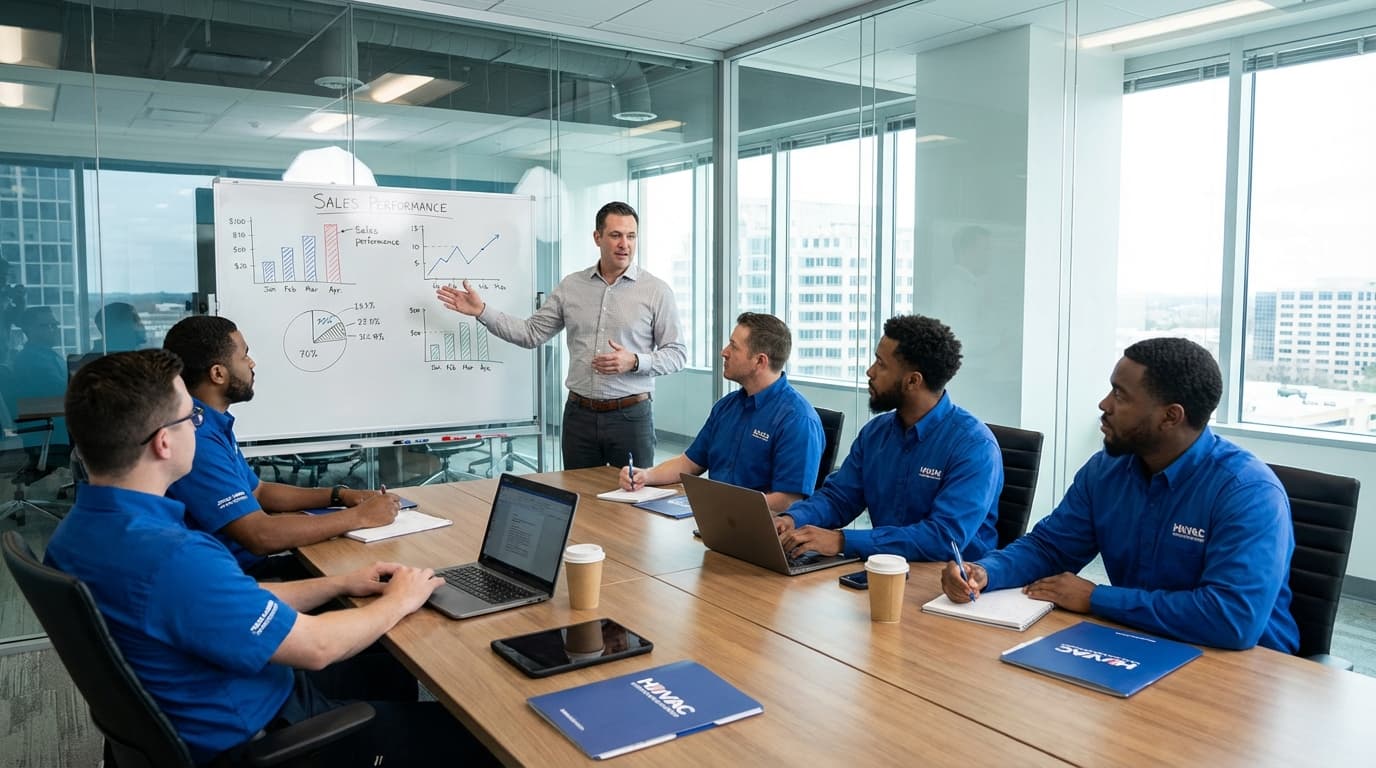
Classroom Training
Best for: Concepts, processes, product knowledge
Frequency: Monthly 2-3 hour sessions
Format:
- Presentation of concepts
- Discussion and questions
- Group exercises
- Quiz or assessment
Topics suited for classroom:
- New product launches
- Process changes
- Sales methodology
- Industry knowledge
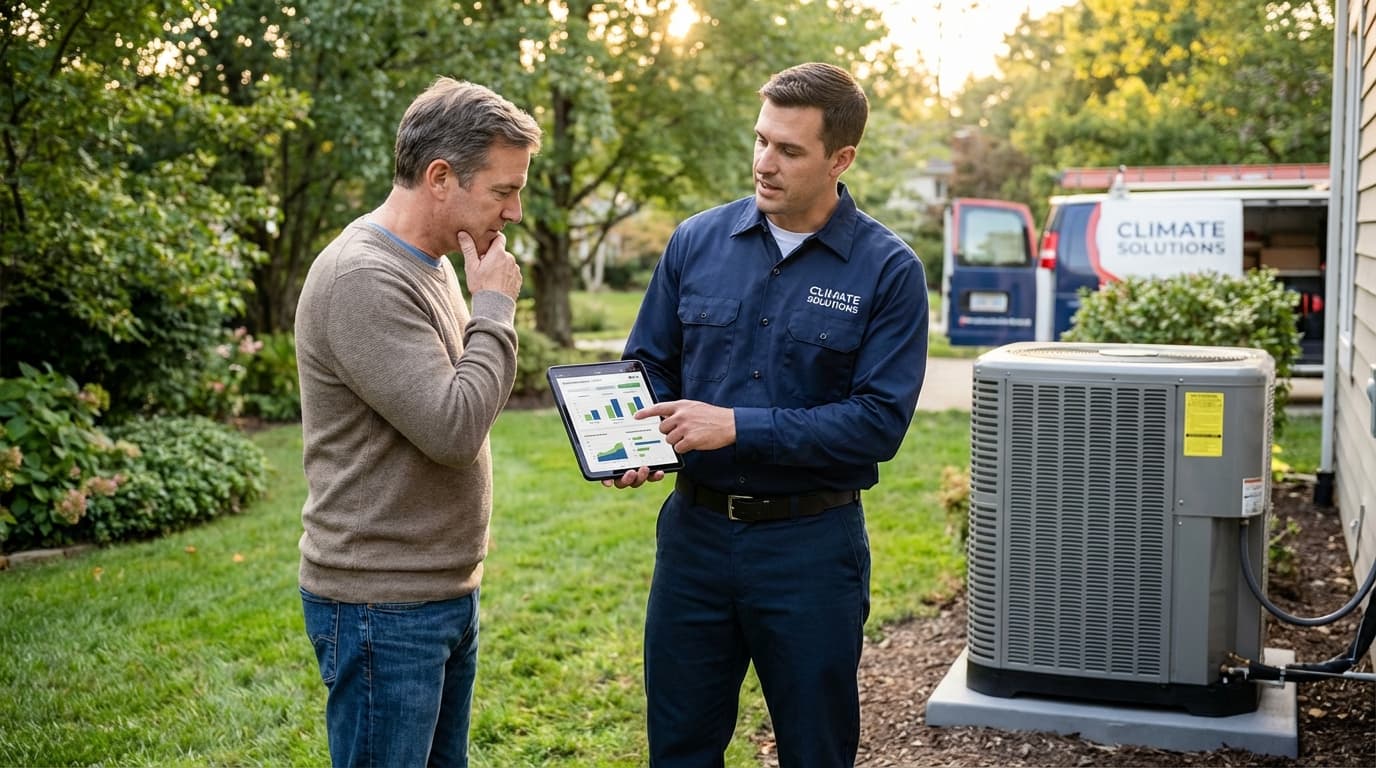
Field Ride-Alongs
Best for: Seeing sales in action, real-time coaching
Frequency: Weekly for new hires, monthly for experienced
Format:
- Trainer observes complete customer interaction
- Notes strengths and areas for improvement
- Debrief immediately after
- Specific action items
Ride-along observation checklist:
- Pre-call preparation
- Arrival and rapport building
- Discovery questions asked
- Technical explanation clarity
- Options presented effectively
- Objections handled well
- Close attempted
Role-Play Practice
Best for: Skill development, objection handling, repetition
Frequency: Weekly 30-minute sessions
Format:
- Pair or small group
- Realistic scenarios
- Immediate feedback
- Repeat until smooth
Role-play scenario examples:
- Price objection from budget-conscious customer
- Spouse says "we need to think about it"
- Customer has lower competitor quote
- Upsell from repair to replacement
- Maintenance agreement pitch after service
Peer Learning
Best for: Knowledge sharing, team building
Frequency: Weekly during team meetings
Format:
- Share wins and how they happened
- Discuss challenging situations
- Collaborative problem-solving
- Top performer demonstrations
Peer learning prompts:
- "What's working for you lately?"
- "Share a tough situation and how you handled it"
- "What objection stumped you this week?"
Measuring Training Effectiveness
Track these metrics to prove ROI and identify gaps.
Leading Indicators (Skill Metrics)
| Metric | How to Measure | Target |
|---|---|---|
| Options presented | % of estimates with 3 options | >90% |
| Close attempted | % of presentations with ask | 100% |
| Follow-up compliance | % of tasks completed on time | >95% |
| Ride-along scores | Average observation ratings | Improving trend |
Lagging Indicators (Results Metrics)
| Metric | Calculation | Benchmark |
|---|---|---|
| Close rate | Closed ÷ Estimates given | 30-45% |
| Average ticket | Revenue ÷ Jobs | Track by service type |
| Upsell rate | Upsells ÷ Opportunities | 25-40% |
| Customer satisfaction | Post-service survey | 4.5+/5.0 |
Individual Performance Tracking
| Rep | Close Rate | Avg Ticket | Upsell % | Trend |
|---|---|---|---|---|
| Smith | 42% | $12,400 | 38% | ↑ |
| Jones | 31% | $10,200 | 22% | → |
| Williams | 24% | $9,800 | 18% | ↓ |
| Team Avg | 32% | $10,800 | 26% | ↑ |
Use individual tracking to identify coaching needs—not to punish, but to develop.
Building a Training Calendar
Structure ensures consistency.
Annual Training Plan
| Quarter | Focus Area | Classroom | Field | Practice |
|---|---|---|---|---|
| Q1 | Fundamentals refresh | 2 sessions | Weekly ride-alongs | Weekly role-play |
| Q2 | Summer selling (AC focus) | 1 session | Bi-weekly | Weekly |
| Q3 | Replacement selling | 2 sessions | Weekly | Weekly |
| Q4 | Winter prep + planning | 1 session | Monthly | Weekly |
Monthly Training Schedule
Week 1: Team meeting with peer learning Week 2: Role-play practice session Week 3: Ride-alongs (rotate through team) Week 4: Classroom training or assessment
New Hire Onboarding (90 Days)
| Period | Focus | Activities |
|---|---|---|
| Week 1-2 | Product and company knowledge | Classroom, study materials |
| Week 3-4 | Sales process and tools | Classroom, CRM training |
| Week 5-8 | Shadowing and assisted selling | Ride-alongs, supervised calls |
| Week 9-12 | Independent with coaching | Solo calls, weekly ride-alongs |
Key milestone: New hire should achieve 70% of team average close rate by day 90.
Common Training Program Mistakes
Avoid these pitfalls.
Mistake 1: Training Once and Forgetting
Problem: Annual training events that get forgotten by February.
Solution: Ongoing weekly touchpoints. Small, frequent doses beat large, rare sessions.
Mistake 2: All Classroom, No Practice
Problem: People learn concepts but don't build skills.
Solution: 50% practice activities (role-play, ride-alongs). Skills require repetition.
Mistake 3: Training Without Accountability
Problem: Training happens but behaviors don't change.
Solution: Track metrics, tie training topics to performance data, follow up on action items.
Mistake 4: Same Training for Everyone
Problem: Top performers bored, struggling reps overwhelmed.
Solution: Segment training by skill level. Advanced sessions for veterans, fundamentals for newer reps.
Mistake 5: Ignoring Mindset
Problem: Techniques taught but not adopted because of resistance.
Solution: Address the "why" before the "how." Connect selling to service and customer benefit.
Scaling Training as You Grow
Adapt the program as your team expands.
3-5 Person Team
- Owner/manager delivers most training
- Weekly role-play at team meetings
- Monthly ride-alongs for everyone
- Peer learning informal
6-15 Person Team
- Designate a sales trainer/manager
- Structured weekly training sessions
- Ride-alongs on rotation schedule
- Peer learning formalized
15+ Person Team
- Dedicated training department or role
- Training curriculum documented
- Multiple trainers/coaches
- Certification and advancement tracks
Frequently Asked Questions
How much should we spend on HVAC sales training?
Budget 2-4% of revenue for training, or $1,000-3,000 per salesperson annually. This includes trainer time, materials, and opportunity cost of training hours. ROI typically returns 5-10x within the first year through improved close rates. Most successful HVAC companies view training as investment, not expense.
Should technicians receive the same training as comfort advisors?
Partially. Both need customer communication and basic selling skills. Comfort advisors need deeper training on consultative selling, complex objection handling, and advanced closing. Technicians need more focus on upsell recognition and handoff procedures. Customize depth by role, but share fundamentals.
How do we measure if training is working?
Track close rate, average ticket, and customer satisfaction before and after training initiatives. Compare by individual to identify who's applying training and who needs more help. Leading indicators (options presented, closes attempted) show behavior change before results metrics move. Expect 60-90 days before significant results metric improvement.
Build Your High-Performance Sales Team
Individual talent creates heroes. Systematic training creates a winning team. The HVAC companies dominating their markets aren't lucky—they're disciplined about developing their people.
Key takeaways:
- Sales is a trainable skill, not an innate talent
- Combine classroom, field, and practice training
- Weekly touchpoints beat annual events
- Measure leading indicators and results
- Address mindset before techniques
Start with the fundamentals—sales process, option presentation, basic objection handling. Build from there. The gap between your top performer and your average will shrink as training becomes systematic.
Your competitors are training their teams. The question is whether you'll fall behind or pull ahead.
Ready to track your team's sales performance? Start your free trial with TruLine and see individual and team metrics that drive coaching conversations.