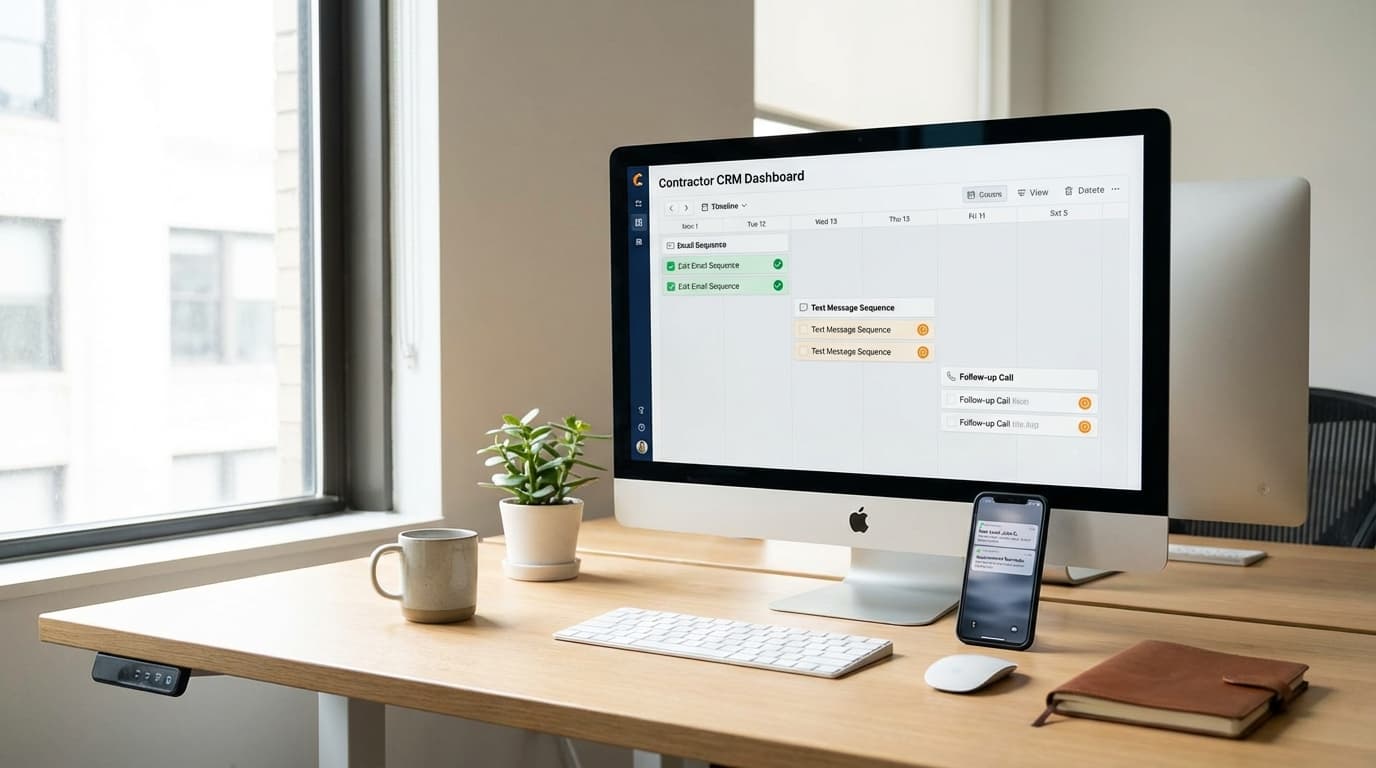
It's 2 PM on the hottest day of July. Your phones are ringing off the hook. Three technicians are on no-cool calls. Your office manager is juggling incoming leads between dispatching emergencies and trying to schedule tomorrow's estimates.
A referral from your best commercial customer calls. She needs a replacement quote for her home—$15,000+ job, easy close. But the call gets logged on a sticky note that falls behind the desk. You don't find it until September. By then, she's bought from your competitor.
This isn't bad luck. It's a system failure. And it's costing HVAC companies thousands in lost revenue every month.
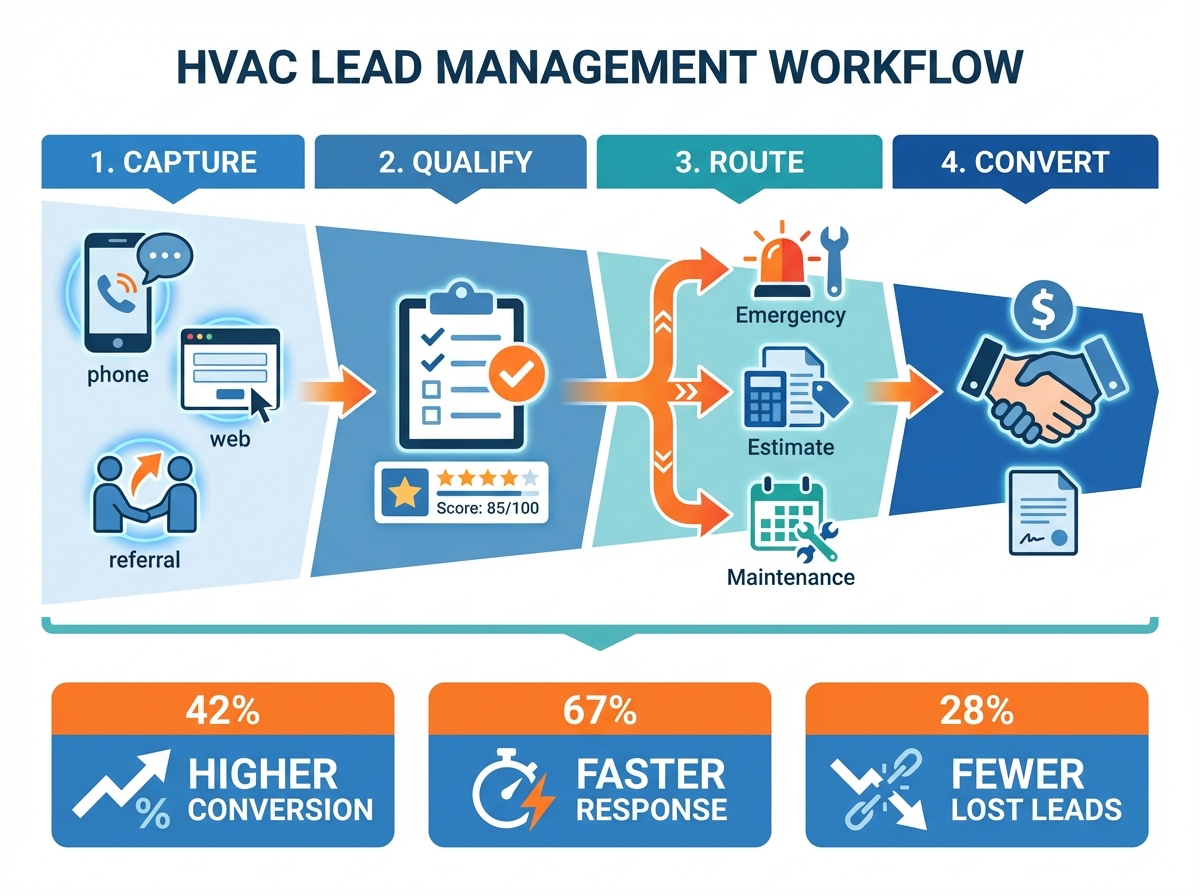
TL;DR: An HVAC lead management system captures every inquiry, routes leads to the right person, triggers timely follow-up, and tracks opportunities through closing. Companies implementing structured lead management report 42% higher lead-to-customer conversion, 67% faster response times, and 28% reduction in lost leads compared to businesses using manual tracking methods.
The right home service CRM provides the foundation, but you need HVAC-specific workflows built on top. Here's how to build a lead management system designed for the unique demands of heating and cooling businesses.
Why HVAC Businesses Need Specialized Lead Management
HVAC lead management differs from generic sales pipelines. The seasonal nature, emergency-versus-planned split, and technical qualification requirements demand purpose-built workflows.
Unique HVAC lead management challenges:
| Challenge | Impact Without System |
|---|---|
| Seasonal demand spikes | Leads slip through during busy periods |
| Emergency vs. estimate mix | Wrong prioritization wastes capacity |
| Technical qualification needed | Unqualified leads consume technician time |
| Long replacement sales cycles | Follow-up drops off, deals die |
| Maintenance agreement renewals | Recurring revenue lost to inaction |
What effective HVAC lead management delivers:
- Every lead captured regardless of channel or timing
- Automatic routing based on lead type and urgency
- Appropriate follow-up cadence for each opportunity type
- Visibility into pipeline and conversion metrics
- Systematic handling of seasonal volume changes
HVAC companies with structured lead management convert 35-45% of qualified leads versus 15-20% for those managing leads informally.
The HVAC Lead Management Framework
Effective lead management follows four stages: Capture, Qualify, Route, and Convert.
Stage 1: Lead Capture
Every inquiry must enter your system. Lost leads are lost revenue.
Capture channels for HVAC:
| Channel | Capture Method | Priority |
|---|---|---|
| Phone calls | Call tracking + CRM integration | Immediate entry |
| Website forms | Auto-create lead in CRM | Immediate entry |
| Email inquiries | Forward to CRM or manual entry | Same-day entry |
| Text/SMS | SMS platform integrated with CRM | Immediate entry |
| Walk-ins | Front desk entry protocol | Immediate entry |
| Referrals | Dedicated referral capture form | Same-day entry |
| Third-party (Angi, etc.) | API integration or manual | Same-day entry |
Required information at capture:
Minimum fields for every lead:
- Contact name and phone number
- Service address
- Lead source (critical for ROI tracking)
- Service needed (emergency/repair/replacement/maintenance)
- Timestamp
Additional fields when available:
- Equipment type and age
- Urgency level
- Budget range
- How they found you
Capture automation:
Configure your CRM to auto-create leads from:
- Call tracking numbers (with recording)
- Website form submissions
- SMS keywords
- Third-party integrations
Manual entry should be the exception, not the rule.
Stage 2: Lead Qualification
Not every inquiry deserves the same investment. Qualification separates opportunities from noise.
HVAC lead qualification criteria:
| Factor | Qualified | Unqualified |
|---|---|---|
| Service area | Within your territory | Outside coverage |
| Authority | Homeowner or authorized | Tenant without permission |
| Need | Clear HVAC issue | Unrelated inquiry |
| Timeline | Ready within reasonable window | "Someday" |
| Budget | Realistic for needed service | Wants free/unrealistic |
Qualification questions for phone intake:
"Are you the homeowner, or do you have authority to approve work?"
"What's the address we'd be servicing?"
"What's happening with your system right now?"
"How soon do you need this addressed?"
"Have you gotten any other quotes?"
Scoring qualification:
Use lead scoring to numerically rate qualification:
| Qualification Factor | Points |
|---|---|
| Homeowner | +15 |
| Within service area | +10 |
| Emergency need | +20 |
| Replacement candidate | +25 |
| Responded to follow-up | +10 |
| Budget stated and realistic | +10 |
| Outside service area | -50 |
| Renter without authority | -30 |
Leads scoring above threshold proceed to routing. Below threshold goes to nurture or disqualification.
Stage 3: Lead Routing
The right lead to the right person at the right time.
HVAC-specific routing rules:
| Lead Type | Route To | Response SLA |
|---|---|---|
| No heat/no cool emergency | Dispatch immediately | 15 minutes |
| Same-day service request | Dispatch queue | 30 minutes |
| Replacement estimate | Sales team/comfort advisor | 2 hours |
| Maintenance agreement inquiry | Inside sales | Same day |
| Commercial inquiry | Commercial sales rep | 2 hours |
| Website "just browsing" | Nurture sequence | 24 hours |
Routing automation:
Configure CRM rules to auto-route based on:
- Service type selected
- Lead score threshold
- Time of day/day of week
- Available capacity
Example routing logic:
IF service_type = "no cooling" AND temperature > 90
  THEN route_to = "emergency_dispatch" AND priority = "urgent"

IF service_type = "replacement" AND home_value > 400000
  THEN route_to = "senior_comfort_advisor" AND priority = "high"

IF lead_score < 20
  THEN route_to = "nurture_campaign" AND priority = "low"
Stage 4: Lead Conversion
Systematic follow-up converts opportunities to customers.
Follow-up cadence by lead type:
Emergency service leads:
- Immediate dispatch or callback
- If not converted same-day, follow up next morning
- Close or disqualify within 48 hours
Replacement estimate leads:
- Same-day appointment scheduling call
- Day 1: Appointment confirmation text
- Day of: Appointment reminder
- Post-appointment: Same-day proposal delivery
- Day 3: Follow-up call if no decision
- Day 7: Second follow-up
- Day 14: Final follow-up or nurture
Maintenance agreement leads:
- Same-day outbound call
- Day 2: Email with agreement details
- Day 5: Follow-up call
- Day 14: Limited-time offer email
- Day 30: Move to long-term nurture
Follow-up automation:
Configure automated touches between manual follow-ups:
- Appointment reminder texts
- Proposal delivery emails
- Educational content sends
- Expiring offer reminders
Human follow-up should focus on qualified, engaged leads. Automation handles the rest.
Building HVAC Lead Workflows
Different lead types require different workflows.
Workflow 1: Emergency Service Leads
Goal: Dispatch fast, convert to service agreement after.
Workflow steps:
- Capture - Call comes in, lead created with "emergency" flag
- Quick qualify - Confirm service area and authority
- Dispatch - Route to available technician immediately
- Service - Technician resolves issue
- Upsell check - Tech evaluates system, notes opportunities
- Post-service follow-up - Office calls to ensure satisfaction
- Agreement offer - Present maintenance agreement within 48 hours
Metrics to track:
- Average response time
- Emergency-to-agreement conversion rate
- Same-day resolution rate
Workflow 2: Replacement Estimate Leads
Goal: Qualify thoroughly, present professionally, follow up systematically.
Workflow steps:
- Capture - Lead enters system with "replacement" tag
- Deep qualify - Phone conversation about system age, issues, budget
- Schedule - Book in-home consultation
- Confirm - Automated appointment reminders
- Consultation - Comfort advisor presents options
- Proposal - Same-day proposal delivery
- Follow-up sequence - Days 3, 7, 14 calls/emails
- Decision - Close or move to long-term nurture
Metrics to track:
- Estimate appointment show rate
- Proposal-to-close rate
- Average days to decision
- Reasons for lost deals
Workflow 3: Maintenance Agreement Leads
Goal: Convert to recurring revenue with high retention.
Workflow steps:
- Capture - Lead expresses maintenance interest
- Qualify - Confirm equipment type and existing coverage
- Present - Explain agreement options and value
- Close - Sign agreement, schedule first visit
- Deliver - Complete first maintenance visit
- Satisfaction check - Follow-up call after first service
- Renewal - 60-day pre-renewal automation
Metrics to track:
- Agreement close rate
- Average agreement value
- First-year retention rate
- Renewal rate
Workflow 4: Seasonal Campaign Leads
Goal: Convert marketing campaign responses efficiently during peak demand.**
Workflow steps:
- Capture - Campaign response logged with source tag
- Quick qualify - Automated qualification questions
- Score - Lead scoring based on responses
- Route - High scores to sales, low to nurture
- Offer - Present campaign-specific offer
- Time limit - Expiring offer creates urgency
- Follow-up - Quick cadence due to promotional nature
Metrics to track:
- Campaign lead volume
- Campaign-specific conversion rate
- Cost per acquisition by campaign
- Offer redemption rate
Technology Stack for HVAC Lead Management
The right tools make lead management scalable.
Core Components
CRM (Customer Relationship Management):
- Stores all lead and customer data
- Manages pipeline stages
- Tracks activities and communications
- Provides reporting and analytics
Call Tracking:
- Unique numbers per marketing channel
- Call recording for training
- Automatic lead creation
- Call duration and outcome logging
Marketing Automation:
- Automated email sequences
- SMS follow-up campaigns
- Lead nurture workflows
- Campaign performance tracking
Dispatch/FSM Integration:
- Connects leads to technician scheduling
- Updates lead status based on service completion
- Syncs customer history across systems
Integration Architecture
Ideal data flow:
Marketing Channels
      ↓
Call Tracking / Web Forms
      ↓
CRM (Lead Created)
      ↓
Qualification + Scoring
      ↓
Routing Rules
      ↓
Sales/Dispatch Assignment
      ↓
FSM (Service Delivery)
      ↓
CRM (Status Update)
      ↓
Marketing Automation (Nurture/Follow-up)
Integration priorities:
- Phone → CRM (most leads come by phone)
- Website → CRM (growing channel)
- CRM → FSM (converts leads to jobs)
- CRM → Email/SMS (automates follow-up)
Measuring HVAC Lead Management Performance
Track these metrics to identify improvements.
Lead Volume Metrics
| Metric | What It Measures | Benchmark |
|---|---|---|
| Total leads/month | Marketing effectiveness | Varies by market size |
| Leads by source | Channel performance | Track trends |
| Leads by type | Service mix | Compare to capacity |
| Lead-to-contact rate | Capture completeness | >95% |
Lead Quality Metrics
| Metric | What It Measures | Benchmark |
|---|---|---|
| Qualification rate | How many meet criteria | 60-80% |
| Average lead score | Overall quality | Track trends |
| Disqualification reasons | Where leads fail | Use to refine targeting |
Conversion Metrics
| Metric | What It Measures | Benchmark |
|---|---|---|
| Lead-to-appointment rate | Interest level | 40-60% |
| Appointment show rate | Commitment level | 85-95% |
| Appointment-to-proposal rate | Consultation quality | 80-90% |
| Proposal-to-close rate | Sales effectiveness | 35-50% |
| Overall conversion rate | System efficiency | 15-25% |
Efficiency Metrics
| Metric | What It Measures | Benchmark |
|---|---|---|
| Average response time | Speed-to-lead | <15 min (emergency), <2 hr (estimate) |
| Average days to close | Sales cycle length | 3-14 days (replacement) |
| Follow-up completion rate | Process adherence | >90% |
| Cost per lead | Marketing efficiency | Varies by channel |
| Cost per acquisition | Overall efficiency | Track and reduce |
Common HVAC Lead Management Problems
Identify and fix these issues proactively.
Problem 1: Leads Falling Through the Cracks
Symptoms: Customers say "no one called me back." Sales reps find old leads in system.
Causes:
- Manual capture processes
- No assignment rules
- No follow-up accountability
Solutions:
- Automate capture from all channels
- Configure automatic routing
- Set SLA alerts for uncontacted leads
- Daily review of unworked leads
Problem 2: Too Slow to Respond
Symptoms: Low conversion rates despite good lead volume. Customers already booked with competitors.
Causes:
- No prioritization system
- Unclear ownership
- Understaffed during peak times
Solutions:
- Implement lead scoring and priority queues
- Set clear response SLAs by lead type
- Staff appropriately for volume
- Automate initial response
Problem 3: Follow-Up Dies After First Contact
Symptoms: Large "proposal sent" pipeline with low conversion. Leads go silent after initial interest.
Causes:
- No systematic follow-up cadence
- Reps "waiting for customer to call back"
- Manual follow-up tracking
Solutions:
- Define follow-up cadences by lead type
- Automate reminder tasks
- Use marketing automation for touches
- Track and report follow-up compliance
Problem 4: Can't Measure What's Working
Symptoms: Unknown ROI by channel. Gut-feel marketing decisions. Can't identify why conversion varies.
Causes:
- Lead source not captured consistently
- Data spread across systems
- No reporting configured
Solutions:
- Require source field on all leads
- Integrate systems to single source of truth
- Build dashboard with key metrics
- Review metrics weekly/monthly
Seasonal Adjustments for HVAC Lead Management
Adjust your system for seasonal demand patterns.
Peak Season (Summer/Winter)
Adjustments:
- Tighten qualification to focus on highest-value leads
- Increase staff/hours for faster response
- Shorten follow-up windows (customers decide faster)
- Prioritize emergencies over estimates
Typical changes:
- Response SLA: Tighten by 50%
- Follow-up cadence: Compress by 30%
- Lead scoring: Raise threshold for sales attention
- Nurture: Pause non-urgent campaigns
Shoulder Season (Spring/Fall)
Adjustments:
- Aggressive outreach on maintenance
- Longer follow-up for replacement prospects
- Proactive campaigns to fill capacity
- Tune-up specials to drive volume
Typical changes:
- Response SLA: Standard
- Follow-up cadence: Extended nurture okay
- Lead scoring: Lower threshold for attention
- Nurture: Activate reengagement campaigns
Off Season (Mild Weather)
Adjustments:
- Focus on agreement sales and renewals
- Replacement nurture campaigns
- Training and process improvement
- Database cleanup and reengagement
Typical changes:
- Response SLA: Standard
- Lead scoring: Accept lower-score leads
- Marketing: Increase outbound campaigns
- Operations: Audit and improve processes
Frequently Asked Questions
How long should I follow up on a replacement lead?
Most HVAC replacement sales close within 14 days or not at all. Follow up actively (calls/personalized emails) for 14 days, then move to automated nurture. Re-engage at seasonal triggers (first hot/cold day) or equipment age milestones. Some leads convert 6-12 months later when circumstances change.
What's a good lead-to-customer conversion rate for HVAC?
Industry benchmarks: 15-25% overall lead-to-customer. By type: Emergency service 70-85%, repair/diagnostic 50-65%, replacement estimates 25-40%, maintenance agreements 40-55%. Your rates depend on lead quality, pricing, and sales effectiveness. Track your own baseline, then improve systematically.
Should I buy leads from third-party services?
Purchased leads (Angi, HomeAdvisor, etc.) can supplement marketing, but typically convert at 2-3x lower rates than organic leads and cost more per acquisition. Track ROI separately. Most successful HVAC companies treat purchased leads as volume supplements, not primary strategy, while investing in generating their own leads through reputation and marketing.
Build Your HVAC Lead Management System
Effective lead management transforms chaotic phone traffic into predictable revenue. Every lead is captured, qualified appropriately, routed to the right person, and followed up systematically.
Key takeaways for HVAC business owners:
- Capture every lead automatically—manual entry loses leads
- Qualify before investing sales time
- Route based on lead type and urgency
- Follow up systematically with defined cadences
- Measure and improve monthly
Start with the biggest leak—typically slow response times or inconsistent follow-up. Fix that, measure the improvement, then tackle the next issue.
Your competitors are leaving money on the table. A systematic approach to lead management picks it up.
Ready to build your HVAC lead management system? Start your free trial with TruLine and see every lead tracked from first call to closed deal.